
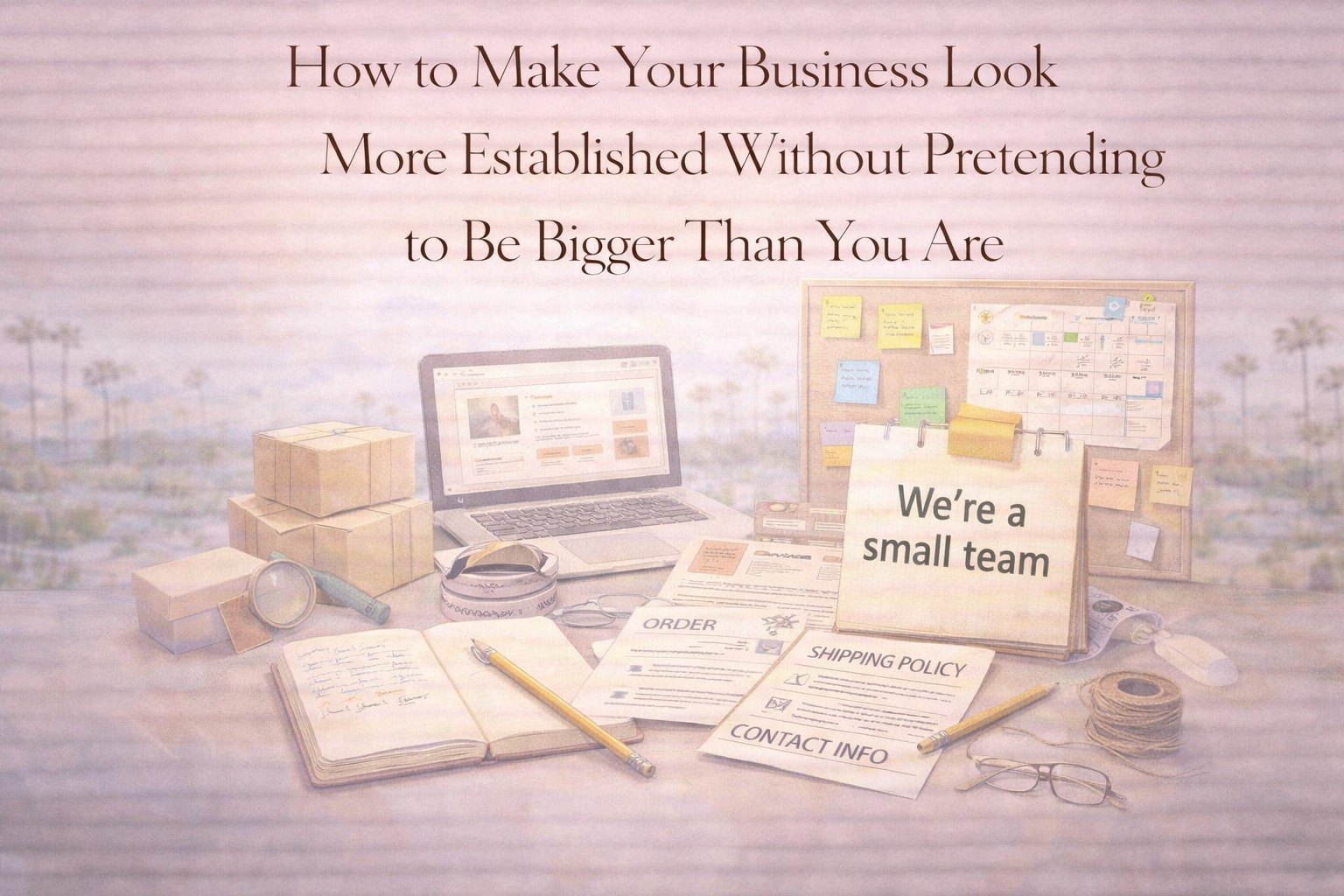
A lot of small businesses think they have two choices.
Either look small and honest, or look polished and slightly fake.
I do not think that is true.
You do not need to invent a giant team, fake a warehouse, perform corporate language, or act like your founder-led business is some faceless machine to look more established online. In fact, that kind of overcompensation usually creates the opposite effect. It makes the brand feel less trustworthy because people can sense when a business is stretching to look bigger than it really is.
The better move is simpler: make the business look more complete, more coherent, and more intentional.
That is what people are actually reading as “established” most of the time.
Established does not mean oversized. It means coherent.
This is the first distinction I would make.
When people say a business “looks established,” they are usually not talking about company size in a literal sense. They are talking about signals.
Does the business look cared for?
Does the website feel complete?
Does the messaging make sense?
Do the pages connect logically?
Does the customer journey feel thought through?
Do the visuals, pricing, copy, and support information all seem to belong to the same company?
That is what makes a brand feel established. Not pretending to be huge. Just showing signs of internal order.
Nielsen Norman Group’s guidance on trustworthy design points to design quality, up-front disclosure, and comprehensive, current content as major credibility factors. That is useful because none of those require fake scale. They require consistency and clarity.
Trying to look bigger often makes a business sound less believable.
This is where founders get themselves into trouble.
They replace normal language with bloated language. They start saying “our team” when it is really just them and maybe one contractor. They write in the tone of a company that has legal, operations, and brand departments when the actual business is still being run from a laptop and a calendar.
That disconnect is easy to feel.
The site sounds formal in a way the rest of the experience cannot support. The voice becomes cold. The language gets vague. The personality disappears. The business starts sounding less like a capable small brand and more like a generic template trying to pass for something larger.
That is usually a downgrade.
Nielsen Norman Group’s research on tone of voice found that tone changes how users perceive friendliness, trustworthiness, and desirability. In other words, the way your business sounds is part of whether people believe you. Voice that feels overly inflated can quietly weaken that trust instead of strengthening it.
Professional is not the same thing as corporate.
I think a lot of small businesses mix those up.
You can be professional without sounding sterile. You can be clear without sounding scripted. You can feel buttoned up without pretending there is a boardroom behind the checkout page.
Professional usually comes from things like:
- clear information
- consistent presentation
- working links and complete pages
- fast, competent replies
- straightforward policies
- language that sounds confident but not inflated
Those are trust builders.
And importantly, they are available to small brands right now. You do not need scale to communicate competence. You need follow-through.
A complete website usually makes a small business feel bigger than fake grandeur does.
This is one of the easiest fixes.
A thin website makes a business feel fragile. A complete website makes it feel more established immediately.
That does not mean stuffing the site with filler. It means having the pages people expect to find and making those pages useful. Homepage, About, product or service pages, contact information, FAQs, shipping or policy information if relevant. When those pieces exist and make sense, the business starts feeling more durable.
A lot of customers are not trying to verify your headcount. They are trying to decide whether you seem real enough to buy from.
Complete structure helps answer that.
Consistency does more work than hype.
This is where many small brands miss an easy opportunity.
They think they need bigger claims when what they really need is fewer contradictions.
If your site looks premium but your emails sound careless, that hurts.
If your social feels thoughtful but your product pages feel rushed, that hurts.
If your branding looks current but your policies are vague or hard to find, that hurts.
If your About page sounds personal and warm but your customer support messages sound robotic, that hurts.
Those inconsistencies make the business feel less established because they make it feel less organized.
Nielsen Norman Group notes that first visual reactions influence perceived relevance, credibility, and usability. The visual part may get you the first nod, but the consistency across the rest of the experience is what keeps that credibility from collapsing.
Clear process makes a business feel more established than vague polish does.
This is especially true for service businesses, custom products, made-to-order work, and founder-led brands.
If a buyer cannot tell what happens next, the business feels less stable.
How do orders work?
How long does shipping take?
What happens after someone books?
How do custom requests get handled?
When should someone expect a reply?
What if something goes wrong?
The more calmly and clearly you answer those questions, the more established the business feels. Not because the company is huge, but because it seems used to operating.
People trust process. It signals maturity.
Social proof helps, but it is not the only proof.
Small businesses sometimes panic if they do not have dozens of testimonials, press mentions, or years of reviews yet.
That is understandable, but it is not the whole picture.
Yes, reviews matter. Testimonials matter. Press can help. But until you have more of that, the business can still feel established through other signals: thoughtful product pages, current content, realistic policies, visible contact information, stronger photos, clearer explanations, and a site that does not leave people guessing.
That is still proof. It is proof of care.
And care reads as legitimacy much faster than founders sometimes realize.
What makes a business feel small in the wrong way
Small is not the problem.
Sloppy is the problem.
Thin copy. Missing pages. weak product photos. vague service descriptions. policies that feel hidden. outdated information. awkward typos. forms that go nowhere. social links that are dead. a homepage that looks polished but does not explain anything. customer emails that sound like afterthoughts.
That is what makes a business feel underbuilt.
Not the fact that it is new. Not the fact that it is lean. Not the fact that it is founder-led.
Small brands often assume people are judging them for being small when in reality people are reacting to signals of disorder.
You can sound honest and still sound established.
This is the sweet spot I would aim for.
You do not need to hide the fact that you are small. You do not need to turn the site into a performance of scale. You just need the business to sound like it knows what it is doing.
That might mean saying things plainly.
“We reply within one business day.”
“Orders ship in 3 to 5 business days.”
“Each piece is made to order.”
“You’ll get an update from a real person if anything changes.”
“We are a small team, but we take communication seriously.”
That kind of language builds more trust than trying to sound like a giant brand that lost access to its own personality.
What I would fix first
If I were helping a small business look more established without faking scale, I would start here:
- Make sure the website feels complete, not thin.
- Clean up the tone so it sounds confident, clear, and human.
- Make policies, contact details, and process information easier to find.
- Improve consistency across the site, emails, product pages, and social presence.
- Use better visuals if the current ones are making the business look less credible than it is.
- Replace inflated language with grounded, competent language.
Most small businesses do not need to act bigger.
They need to look more organized.
The bottom line
You can make your business look more established without pretending to be bigger than you are.
In fact, that is usually the better move.
Because “established” is less about scale than people think. It is mostly about coherence, clarity, completeness, and the feeling that the business can be trusted to do what it says it will do.
That is the real shortcut.
Not fake grandeur.
Just a brand experience that feels like a competent adult built it on purpose.
Leave a Reply