
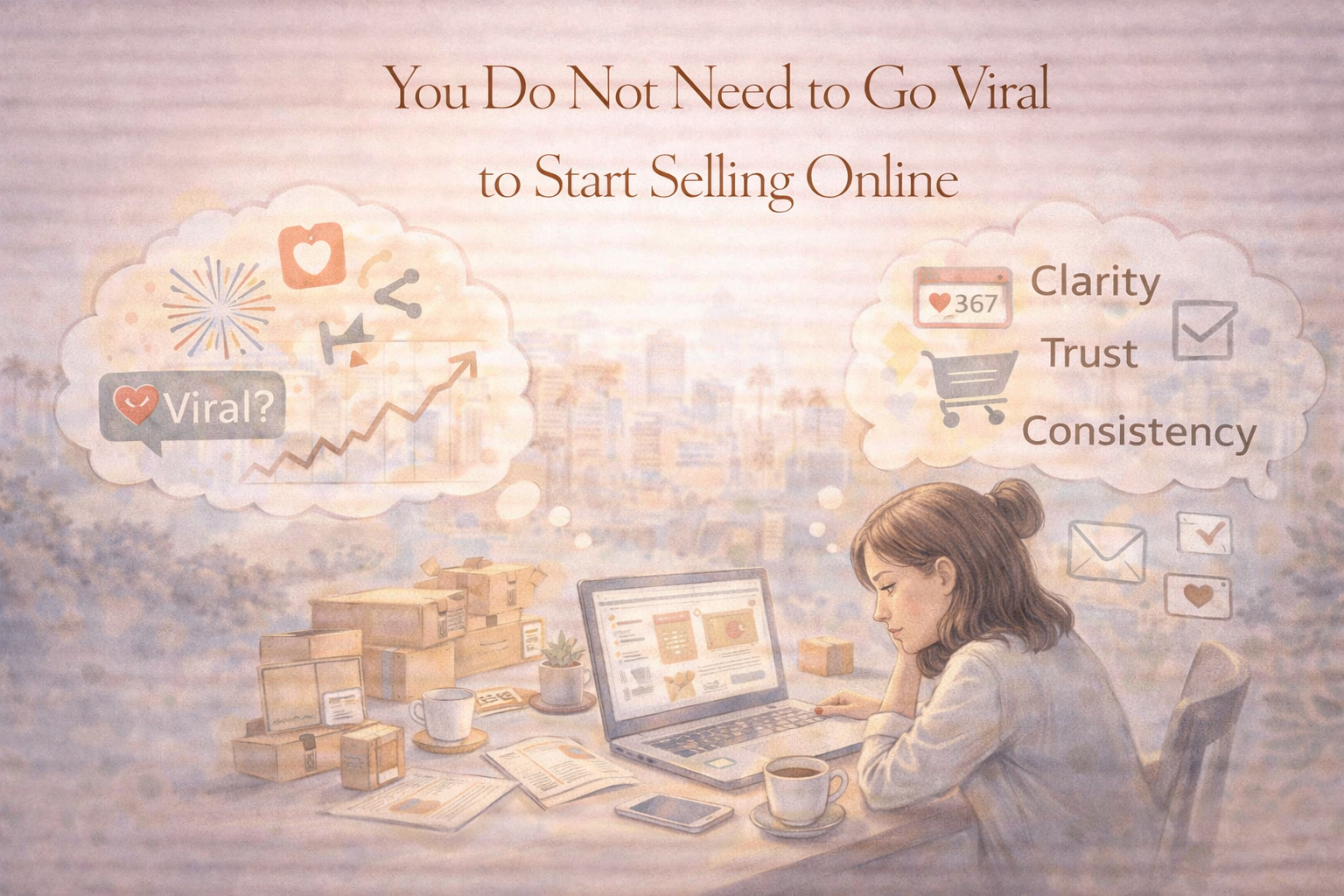
You Do Not Need to Go Viral to Start Selling Online
A lot of new online sellers think the path looks something like this: post content, hit the right trend, catch a wave of attention, and then finally start making sales.
I understand why that story is so attractive.
Virality feels like a shortcut. It turns the hardest part of building a small business, getting noticed, into a fantasy of sudden escape. One good video, one big post, one lucky moment, and now the brand is “out there.”
The problem is that going viral is not a business model.
It is an outcome you do not control very well, usually on a platform you do not control at all.
And more importantly, it is not required to start selling online.
Attention is useful. Familiarity is what usually does the selling.
This is the first mindset shift I would make.
Virality is a spike. Selling is usually a repetition game.
Most people do not buy from a new small brand the first time they see it unless the need is immediate, the offer is unusually clear, or the trust signals are already strong. More often, they need a few exposures. They need to see the product again, hear the brand in a recognizable voice, understand what makes it different, and feel a little more certain that the business is real and worth buying from.
That is why I think a lot of new sellers are aiming at the wrong target. They are chasing maximum visibility when what they actually need is enough repeated visibility to build recognition and confidence.
That lines up with what larger marketing research is pointing to right now. HubSpot’s 2026 State of Marketing report says growth is increasingly driven by distinctiveness, trust, and relevance as markets fill up with more content and more polished sameness. That is a much better lens for small brands than “maybe this one blows up.”
Virality is often overvalued because it is visible.
This is part of the trap.
Everybody can see views. Everybody can see likes. Everybody can see the giant comment count, the reposts, the follower jump, the dopamine hit of “people are noticing this.” It looks like momentum, and sometimes it is.
But visible attention and useful attention are not always the same thing.
A post can travel very far and still bring in the wrong audience.
A reel can rack up views and still explain almost nothing about the product.
A trend can make the brand briefly legible to the algorithm while making it more forgettable to actual buyers.
That is one reason recent consumer research has been so useful. Sprout Social’s 2025 Index reporting found that a third of consumers think jumping on viral trends is embarrassing for brands. That does not mean trends never work. It does mean trend fluency and actual brand-building are not the same thing.
What social media is actually good for at the beginning
If I were stripping the fantasy away, I would say social media is most useful for small brands when it does a few specific jobs well.
- It helps people discover that the brand exists.
- It helps the brand become more familiar over time.
- It gives buyers proof that the business is active and real.
- It lets the seller show product, process, standards, and personality in repeatable ways.
- It creates enough recognition that the eventual buying decision feels less risky.
That is much more practical than “go viral.”
It is also much more repeatable.
Sprout Social’s 2026 interaction reporting says 58% of social users believe audience interactions are the most important thing for brands to prioritize on social. That is a helpful reminder that the audience is paying attention to how brands show up repeatedly, not just whether they can manufacture one big spike.
People buy from brands they recognize faster than brands they just discovered.
This is one of the quiet truths new sellers usually learn a little late.
Recognition lowers friction.
If someone has seen the product before, heard the brand voice before, or watched the business show up consistently over time, the eventual purchase feels more familiar and therefore less risky. That does not guarantee a sale, obviously, but it changes the temperature of the decision.
This is especially important for small brands because they do not have built-in scale doing the trust work for them. They need the customer to feel like the business is real enough, active enough, and consistent enough to deserve a chance.
Edelman’s 2025 Brand Trust report shows that people who fully trust a brand are much more likely to purchase, stay loyal, and advocate for it. Small brands are not exempt from that dynamic. They just have to build that trust with fewer shortcuts.
Going viral can actually distort what your business needs.
This is the part people talk about less.
A lot of early brands do not actually need a giant burst of random attention. They need clearer offers, stronger product pages, better photos, better explanations, and more buyer confidence once people land on the site.
If those basics are weak, virality just exposes the weaknesses faster.
The brand gets traffic, but not enough conversion.
The content gets attention, but the audience is poorly matched.
The video performs, but the website does not support the interest.
The comments fill up, but the business still feels hard to understand.
That is not a visibility problem. It is a readiness problem.
HubSpot’s 2026 marketing statistics roundup lists lead-to-customer conversion among the most important KPIs marketers track and notes that conversion rate optimization is one of the most-used optimization techniques. That is a useful reminder that attention only becomes valuable when the destination can support it.
Small brands usually need consistency more than cleverness.
This is one of the least glamorous truths in online selling.
You do not usually need the smartest post in the room. You need enough consistent output that people start to understand what you sell, why it matters, and what kind of brand you are.
That might look like product demos, process videos, repeated use-case content, packaging moments, customer education, behind-the-scenes clips, FAQs, restock updates, founder perspective, or just clear posts that keep reinforcing the same useful story.
The point is not to flood the feed. The point is to make the brand easier to recognize over time.
That also fits what buyers say they want. The 2025 Sprout Social Index was based on more than 4,000 consumers who follow at least five brands on social media, which is useful context because it means consumers are used to repeated exposure to brands in-feed. Small businesses are not competing for one magical moment. They are competing for pattern recognition.
Virality often rewards the wrong thing for product brands.
This is especially true when the content becomes more interesting than the product.
A funny post can go off. A trend remix can go off. A founder rant can go off. A relatable joke can go off. But if the thing that travels is disconnected from what the business actually sells, then the attention may not build much commercial value.
You got distribution, but not necessarily alignment.
That is why I think product brands need to ask a stricter question than “Could this pop?”
The better question is “If this performs, does it make the brand easier to buy from?”
If the answer is no, the content might still be entertaining. It just may not be doing enough business work.
What usually works better than chasing virality
If I were helping a new seller build momentum online, I would care more about:
- a clear offer people can understand fast
- a website that does not create unnecessary doubt
- product pages that answer real buyer questions
- consistent content that reinforces recognition
- proof that the business is active, competent, and real
- repeatable content formats the brand can sustain without burning out
That is not flashy advice. It is better advice.
Because once those pieces are in place, the business can actually benefit from larger visibility when it comes. Without them, the brand is just hoping scale arrives before clarity does.
What I would measure instead
If I were a beginner seller, I would care less about whether a post “blew up” and more about whether the brand is becoming easier to recognize and trust.
That might mean watching things like:
- repeat profile visits
- site traffic from social that actually sticks
- email signups
- saves and shares from the right audience
- direct messages with real buying questions
- sales from people who say they have been following for a while
Those are often more useful signals than raw reach, especially early on.
The bottom line
You do not need to go viral to start selling online.
You need enough attention from the right people, enough clarity that they understand what you are selling, and enough consistency that the brand feels familiar by the time they are ready to buy.
Virality can help if it happens. It is just not the job description.
The real job is simpler and less cinematic:
show up clearly, show up repeatedly, and make the business easier to trust every time someone sees it.
That is usually how selling starts.
Not with a spike.
With recognition that finally feels safe enough to turn into action.
Leave a Reply