
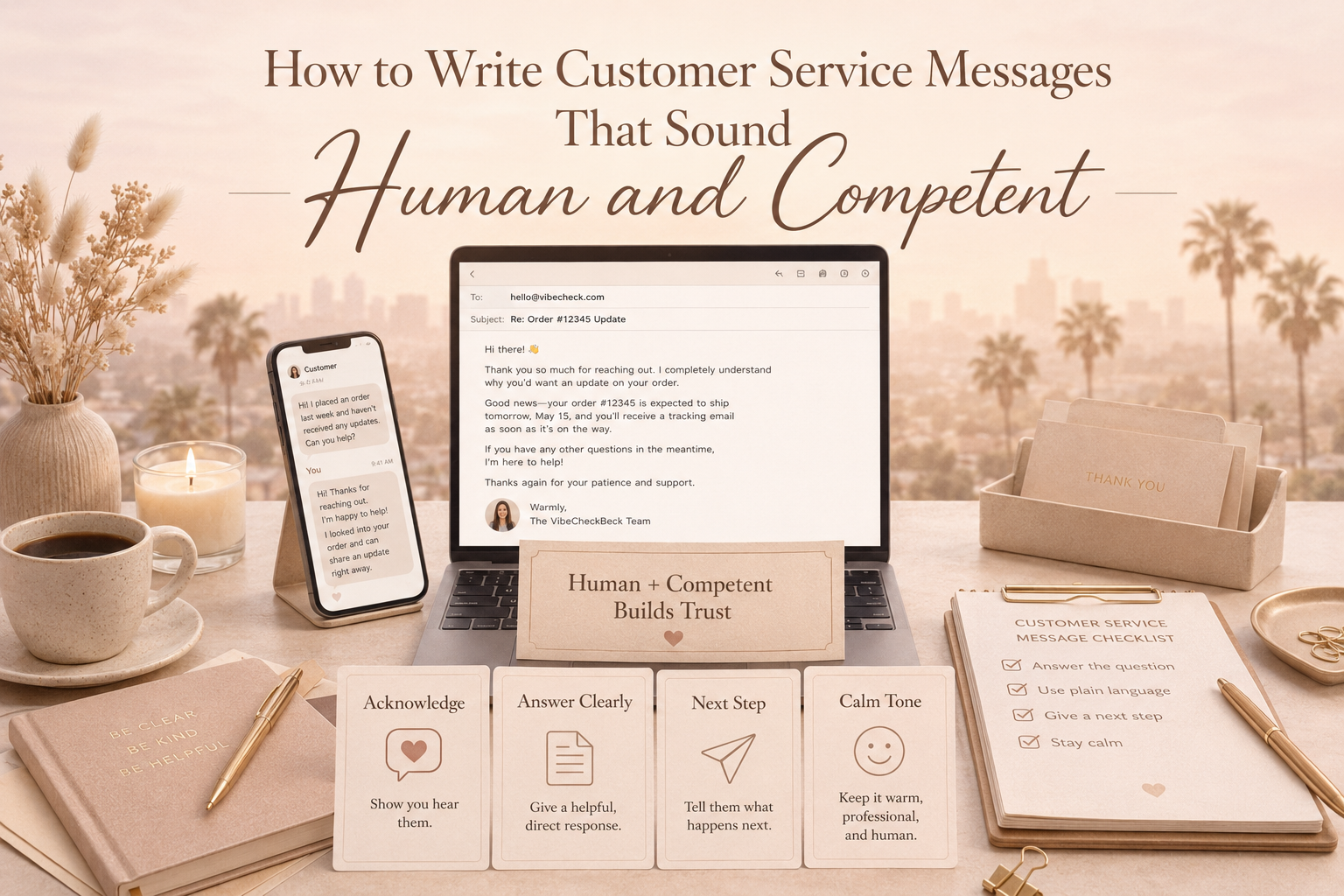
Customer service messages should feel clear, calm, helpful, and human. Learn how small brands can write replies that build trust without sounding robotic or defensive.
Customer service messages do not need to sound complicated to be professional. In fact, the best ones usually do the opposite. They make the customer feel seen, give them the information they need, and explain the next step without turning a simple issue into a formal performance.
For small brands, this matters because every message carries more weight. A customer may not know your business well yet. They may not have years of reviews, brand familiarity, or corporate infrastructure to lean on. They are using your communication to decide whether the business feels trustworthy.
That does not mean every reply needs to be perfect. It means every reply should feel clear, steady, and useful.
The goal is simple: sound like a real person who knows what they are doing.
Human and Competent Should Work Together
Some businesses sound human but not competent. Their replies are friendly, casual, and warm, but they do not actually answer the customer’s question. They say things like, “No worries, we got you!” and then leave out the timeline, policy, tracking detail, or next step the customer needed.
Other businesses sound competent but not human. Their replies contain information, but the tone feels cold, legalistic, or robotic. They sound like a policy page with a pulse.
Small brands need both.
A good customer service message should make the customer feel that a real person read the message and that the business has a process. Warmth without clarity creates confusion. Clarity without warmth can feel harsh. The best replies combine the two.
Human means the message sounds thoughtful and natural. Competent means the message answers the question and moves the situation forward.
Start by Acknowledging the Customer’s Actual Concern
One of the easiest ways to make a message feel human is to reflect what the customer actually said.
A generic reply like “Thanks for reaching out” is fine, but it is not always enough. If the customer has a problem, question, or concern, name it. That small detail shows that you read the message carefully.
For example, if a customer says their order arrived damaged, a stronger reply might begin: “Thank you for letting me know. I am sorry the mug arrived cracked, and I can help with the next step.”
If a customer asks whether a service includes revisions, a stronger reply might begin: “Great question. Yes, revisions are included in the full package, and I can explain how that part works.”
This does not require a long emotional introduction. It only requires enough specificity to show the customer they are not receiving a copy-and-paste answer that ignored the point.
Answer the Question Before Adding Extra Context
Customers usually want the answer first.
If they ask when something ships, tell them the shipping timeline. If they ask whether returns are accepted, tell them the return window. If they ask what is included, tell them what is included. If they ask what happens next, explain the next step.
Extra context can be helpful, but it should not bury the answer.
A customer who asks, “When will my order ship?” does not need a long explanation about how busy the shop has been, how many orders came in this week, or how carefully each package is prepared before they receive the actual timeline.
A better answer starts clearly: “Your order is scheduled to ship by Thursday. You will receive tracking as soon as it is on the way.”
That message gives the customer what they came for. After that, you can add a warm note if needed: “Thank you for your patience while we prepare it.”
Clear first. Warm second. Extra details only when they help.
Use Plain Language
Professional customer service does not need to sound corporate. It needs to sound understandable.
Customers should not have to decode the message. Avoid language that sounds inflated, evasive, or overly formal. Phrases like “we are currently investigating the matter” or “your request has been escalated for review” may be appropriate in some larger systems, but for many small brands, they can feel cold and vague.
Plain language is usually stronger.
Instead of “We are currently investigating the matter,” try: “I am checking the order details now.”
Instead of “Your request has been escalated,” try: “I am sending this to our shipping partner and will update you by tomorrow afternoon.”
Instead of “We regret any inconvenience,” try: “I am sorry this caused frustration.”
The simpler version often feels more trustworthy because it sounds like someone is actually handling the issue.
Give the Customer a Next Step
A customer service message should rarely end in a dead stop.
When possible, tell the customer what happens next. This is one of the fastest ways to make a reply feel competent. It gives the customer direction and reduces the need for follow-up messages.
If you need more information, ask for it clearly. If you are checking something, give a timeline. If the customer needs to wait, explain what they are waiting for. If the issue is resolved, tell them what confirmation they should expect.
For example: “Please send a photo of the damaged item and the packaging. Once I have that, I can start the replacement process.”
Or: “I am checking the tracking history today and will send you an update by tomorrow afternoon.”
Or: “Your refund has been processed. You should see it return to your original payment method within five to seven business days, depending on your bank.”
The next step is what keeps the customer from feeling stuck.
Do Not Over-Apologize
An apology matters when something goes wrong, but too much apology can make the business sound nervous, disorganized, or unsure of itself.
A customer does not need five sentences of guilt before getting help. They need a clear acknowledgment and a useful path forward.
Instead of writing, “We are so, so sorry this happened. We feel terrible and completely understand how frustrating this must be. This is not the experience we wanted you to have,” keep it calmer.
Try: “I am sorry this arrived damaged. I can help you with the replacement process now.”
That message is still human. It still takes the customer seriously. But it does not make the customer manage the business owner’s emotions.
The best apology is paired with action.
Do Not Sound Defensive
Defensiveness is one of the quickest ways to turn a manageable issue into a bigger trust problem.
This often happens when a customer asks about a delay, a policy, or a mistake and the business owner feels personally criticized. That is understandable, especially for small brands where the work feels personal. But the customer does not need to hear the business defending itself before receiving help.
A defensive reply might say: “As stated on our website, shipping takes five business days, and we cannot control carrier delays.”
A more helpful version would be: “Our standard processing time is five business days, and your order is still within that window. Once it ships, you will receive tracking. If the tracking does not update after it leaves us, I can help you review the next step.”
The second version still explains the boundary. It simply does it without making the customer feel scolded.
Make Boundaries Sound Calm
Small businesses need boundaries. Not every request can be approved. Not every item can be refunded. Not every deadline can be moved. Not every customer expectation can be met exactly.
The way those boundaries are communicated matters.
A boundary should be clear, but it does not need to sound irritated. Customers are more likely to accept a limit when the explanation is calm and specific.
For example, instead of saying, “We do not accept returns on custom orders,” try: “Because custom orders are made specifically for each customer, they are final sale once production begins. I can still help you review the details before the order is confirmed.”
Instead of saying, “We cannot rush this,” try: “This process takes three business days so we can complete it carefully. The earliest available completion date is Thursday.”
Calm boundaries make the business feel steady. They also protect the relationship while protecting the business.
Use Templates, But Do Not Let Them Sound Lifeless
Templates can be helpful, especially for common questions. A small business owner should not have to rewrite the same shipping, refund, sizing, or booking explanation every day.
But templates should still feel like they were written by a person.
The problem is not using a template. The problem is sending one that ignores the customer’s specific message. A good template gives structure, but it should leave room for personalization.
A simple structure might look like this:
- Acknowledge the specific question or issue.
- Give the direct answer.
- Explain the next step.
- Add a warm closing sentence.
For example: “Thanks for checking in about your order. It is scheduled to ship by Thursday, and you will receive tracking as soon as it is on the way. If you do not see tracking by Thursday evening, reply here and I will check it for you.”
That could be a template, but it still feels useful because it answers the actual question.
Match the Tone to the Moment
Not every customer message needs the same tone.
A quick product question can be answered with light warmth. A damaged order needs more care. A refund request needs clarity and calm. A confused customer needs guidance. An upset customer needs steadiness.
The tone should fit the situation.
If a customer is excited, it is fine to reflect a little enthusiasm. If a customer is worried, reassure them. If a customer is frustrated, keep the reply calm and focused on the solution. If the answer is no, be respectful and specific.
Human customer service does not mean sounding overly casual all the time. It means understanding the emotional temperature of the message and replying in a way that helps.
Show That There Is a Process
Competent messages make customers feel that the business has a process.
This is especially important when something goes wrong. A customer does not want to feel like the business owner is improvising, guessing, or deciding based on mood. They want to know there is a clear way to handle the issue.
You can show process with simple language.
“Here is what happens next.”
“Once I receive the photo, I can begin the replacement request.”
“Refunds are reviewed within two business days.”
“Tracking usually updates within twenty-four hours after the package is scanned.”
These sentences make the business feel organized because they explain how the situation works. Customers do not need to see your entire back-end system. They just need enough structure to feel safe.
Write Like Someone Who Is Paying Attention
The most human customer service messages often include small signs of attention.
Use the customer’s name when appropriate. Mention the item, order, date, service, or detail they asked about. Answer all parts of the question. Do not make them repeat information they already gave you.
For example, “I see that you ordered the ivory planner and selected standard shipping. That order is scheduled to ship by Wednesday.”
That kind of detail reassures the customer because it proves you are looking at their actual situation.
Attention is one of the small business advantages. Larger companies often make customers feel like case numbers. A small brand can make customers feel recognized without being overly familiar or unprofessional.
Examples of Stronger Customer Service Messages
A good message does not need to be long. It needs to be complete.
For a shipping question:
“Thanks for checking in. Your order is scheduled to ship by Thursday, and tracking will be sent automatically once it is on the way. If you do not see tracking by Thursday evening, reply here and I will look into it.”
For a damaged item:
“I am sorry your order arrived damaged. Please send a photo of the item and the packaging, and I will help you start the replacement process.”
For a refund question:
“Our refund window is seven days after delivery for unused items. If your order is eligible, I can help you begin the return process. If the item arrived damaged, send a photo and I will review that separately.”
For a service inquiry:
“Yes, that is included in the full package. The starter package includes the initial strategy session and written recommendations, while the full package includes revisions and implementation support.”
For a delayed answer:
“Thank you for your patience. I am still waiting on the carrier update, but I have not forgotten this. I will check again tomorrow morning and send you the next update by noon.”
Each of these replies sounds human because it is written plainly. Each sounds competent because it gives the customer something useful.
The Message Should Leave the Customer Calmer Than Before
This is a simple test for customer service writing: does the message make the customer feel calmer, clearer, or more confident than they felt before?
If the answer is yes, the message is probably doing its job.
If the message creates more questions, sounds defensive, hides the answer, or gives the customer no next step, it needs work.
Small brands do not need to sound like large customer service departments. They need to sound steady, thoughtful, and capable. That is often more powerful than corporate polish.
A customer service message is not just a reply. It is a tiny trust-building moment. It tells the customer whether the brand is paying attention, whether the business knows how to handle its own process, and whether buying from this brand feels safe.
Human and competent is the balance.
Kind enough to feel personal. Clear enough to feel professional. Useful enough to move the customer forward.
That is the kind of customer service writing small brands should aim for.
Leave a Reply