
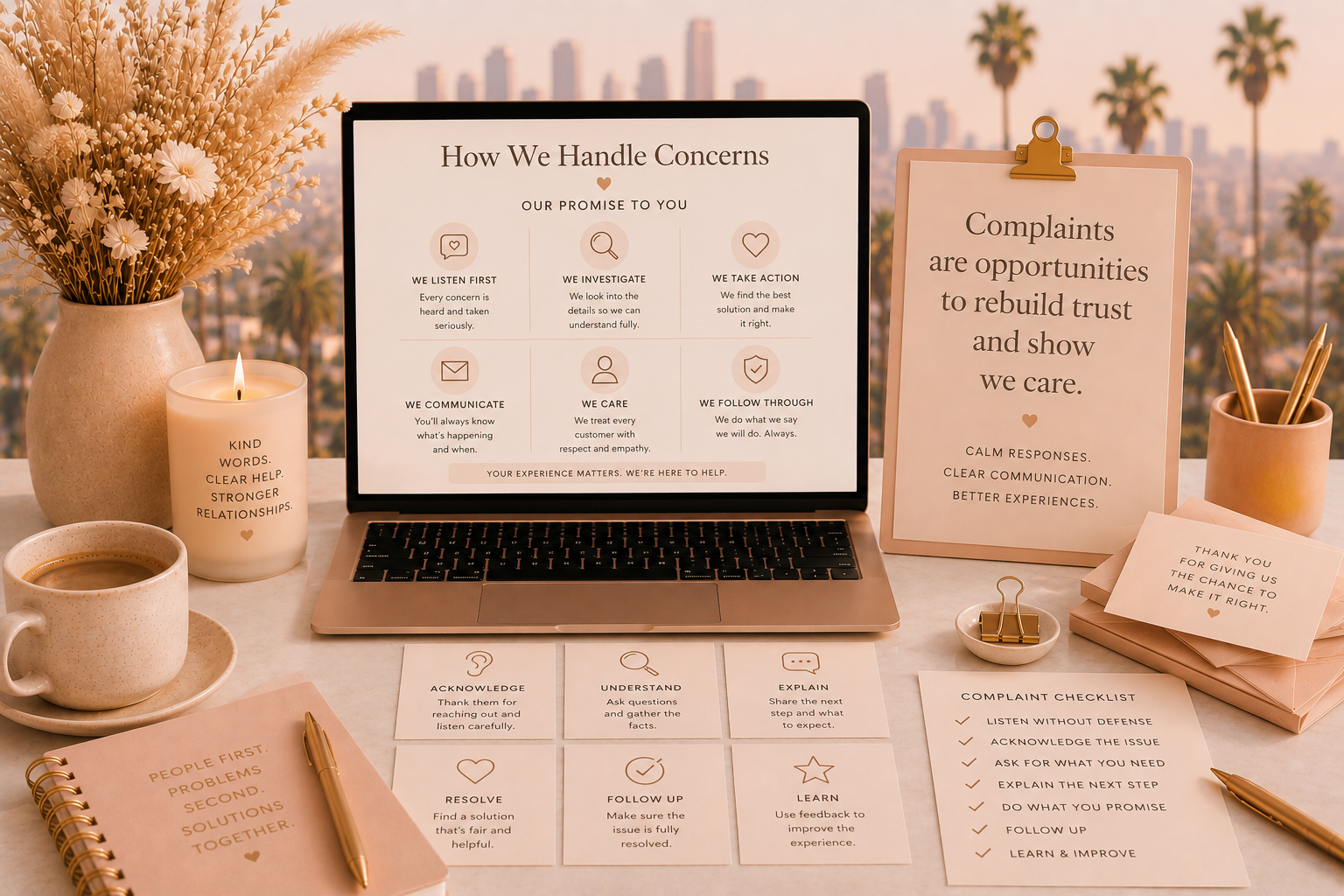
Customer complaints can damage trust or strengthen it, depending on how a small brand responds. Learn how to handle complaints with clarity, calm, and professionalism.
No small business owner loves receiving a complaint.
Even when the message is polite, it can feel uncomfortable. A customer is unhappy. Something went wrong. A product disappointed them. A package arrived late. A service did not match what they expected. A detail was missed. A process that felt normal from inside the business felt confusing from the customer’s side.
For small brands, complaints can feel especially personal because the business itself often feels personal. The product, service, website, packaging, photos, emails, and policies may all come from the same small team, or even one person. So when a customer says something is wrong, it can feel like they are criticizing the entire business.
But a complaint is not always an attack.
Sometimes it is a customer trying to get help. Sometimes it is a customer showing you where the experience broke down. Sometimes it is the last chance to protect trust before frustration turns into a review, refund request, chargeback, or lost relationship.
The way a business handles complaints tells customers a lot about the brand.
The Customer Should Not Have to Prove They Deserve Help
One of the fastest ways to make a complaint worse is to make the customer feel like they are on trial.
That does not mean every customer is right. It does not mean every request should be approved. It does not mean a business should ignore policies, absorb every cost, or let unreasonable people control the tone of the interaction.
It means the first response should not make the customer feel accused.
If someone says an item arrived damaged, begin by acknowledging the problem and asking for what you need. If someone says their order is late, check the status before sounding defensive. If someone says they are confused about a service, explain the process instead of implying they should have understood it already.
A complaint should be handled like a customer experience issue first and a policy issue second.
Start With Acknowledgment
Acknowledgment is not the same as admitting fault.
You can acknowledge what the customer is experiencing without immediately taking blame for every part of the situation. That distinction matters, especially when the issue involves shipping carriers, customer error, third-party platforms, or expectations that were not fully aligned.
A good acknowledgment sounds calm and specific.
“Thank you for letting me know. I am sorry the package arrived damaged, and I can help you with the next step.”
“I understand why that would be frustrating. I am checking the order details now so I can give you a clear update.”
“Thank you for explaining what happened. I want to make sure I understand the issue correctly before we move forward.”
These replies do not panic. They do not overpromise. They do not sound cold. They simply tell the customer that the concern has been heard.
Avoid the Defensive Reflex
Defensiveness is natural, but it is rarely useful in customer service.
Small business owners often know how much work went into the order, product, or service. They know how carefully things were packed. They know how clear they thought the policy was. They know the shipping delay was not their fault. They know the customer may have missed a detail that was already on the website.
That may all be true.
But if the first response sounds defensive, the customer usually feels dismissed.
Compare these two replies:
“As stated on our website, shipping delays are not our responsibility once the package leaves our facility.”
“Once the package is with the carrier, delivery timing can vary. I know that is frustrating, so I am checking the tracking now and can help you review the next step.”
The second response still protects the boundary. It just does not make the customer feel scolded for asking.
Ask for What You Need Clearly
Sometimes a complaint cannot be resolved until the customer provides more information.
That is reasonable. The business may need an order number, photos of the item and packaging, screenshots, a description of the problem, or confirmation of the shipping address. The key is to ask clearly and explain why the information is needed.
Instead of saying, “Send proof,” try a more helpful version:
“Please send a photo of the damaged item and the packaging it arrived in. This helps me document the issue and start the replacement process.”
Instead of saying, “What is your order?” try:
“Can you send your order number or the email address used at checkout? That will help me pull up the order and check the status faster.”
Clear requests make the process feel organized. They also keep the customer from feeling like the business is asking questions just to delay the outcome.
Explain the Next Step
Complaints become more stressful when the customer does not know what happens next.
Once you understand the issue, explain the next step in plain language. Will you review the order? Contact the carrier? Send a replacement? Process a refund? Escalate the issue? Check inventory? Follow up by a certain time?
A clear next step gives the customer something to hold onto.
For example:
“Once I receive the photos, I will review them and confirm the replacement option within one business day.”
“I am checking the tracking history now. If the package has not moved by tomorrow afternoon, I will contact the carrier and update you.”
“I am reviewing your request against our return window and will send the next step by the end of the day.”
The customer may not get an instant resolution, but they should never feel abandoned inside the process.
Use Policies as Guidance, Not a Shield
Policies matter. They protect the business, create consistency, and help customers understand what to expect. But policies should not be used as a wall between the brand and the customer.
A policy should guide the conversation.
Instead of replying with only, “Please see our return policy,” summarize the part that applies and then link to the full policy if needed.
For example:
“Our return window is seven days after delivery for unused items. Since your order arrived three days ago, it is still within that window. I can help you begin the return process here.”
Or:
“Because custom orders are made specifically for each customer, they are final sale once production begins. I can still help you review the approved details so we can understand what happened.”
This approach keeps the policy clear while still treating the customer like a person.
Stay Calm When the Customer Is Upset
Not every customer complaint will arrive in a perfect tone.
Some customers will be frustrated. Some will be blunt. Some will be emotional. Some will be unfair. Some will be wrong about part of the situation. A business owner still has to decide what kind of tone the brand will use in response.
Matching the customer’s frustration usually makes the situation worse.
A calm reply does not mean accepting disrespect. It means refusing to let the interaction become messier than it needs to be. The best response stays focused on the issue, the facts, and the next step.
For example:
“I understand this has been frustrating. I can help review the order, but I need the conversation to stay focused on the issue so we can move forward.”
That sentence sets a boundary without escalating the tone.
Do Not Over-Apologize
An apology can be useful, but too much apology can make the business sound unstable.
Customers usually do not need a long emotional response. They need acknowledgment, information, and action. A simple apology followed by a clear next step is often stronger than a dramatic apology that still leaves the customer unsure what happens next.
Instead of writing a paragraph about how terrible you feel, try:
“I am sorry this happened. I can help you start the replacement process now.”
Or:
“I am sorry for the confusion. Here is how the process works and what we can do next.”
The apology should support the resolution, not replace it.
Know When to Say No Clearly
Handling complaints well does not mean saying yes to everything.
Sometimes the customer is outside the return window. Sometimes the item was used in a way the policy does not cover. Sometimes the service was delivered according to the agreed scope. Sometimes a refund request is not eligible. Sometimes the answer is no.
The goal is to make the no clear, fair, and respectful.
A weak no sounds irritated or vague. A stronger no explains the reason and, when possible, offers a helpful alternative.
For example:
“Because this order is outside the seven-day return window, I am not able to process a refund. I can still help you review the care instructions or answer any product questions.”
That answer does not bend the policy, but it also does not punish the customer for asking.
Follow Through Exactly When You Said You Would
Follow-through is where trust is either repaired or lost completely.
If you tell a customer you will follow up tomorrow, follow up tomorrow. If you say a refund will be processed by Friday, make sure it is processed by Friday or send an update before the customer has to ask. If you are waiting on information from a carrier or supplier, check back when you promised.
A complaint already puts trust under pressure. Missing your own communication promise adds a second problem on top of the first.
Even a small update matters.
“I am still waiting on the carrier response, but I have not forgotten this. I will check again tomorrow morning and update you by noon.”
That kind of follow-through tells the customer that the business is still present, even if the final answer is not ready yet.
Look for the Pattern After the Complaint Is Resolved
Once the immediate issue is handled, the business should look at what the complaint revealed.
Was the policy unclear? Was the shipping timeline too vague? Was the product page missing an important detail? Did the customer misunderstand the service because the scope was not explained well enough? Did the confirmation email fail to set expectations?
Not every complaint means the business needs to change something. But repeated complaints usually point to a system issue.
If customers keep having the same problem, the answer is not just better replies. The answer may be better content, clearer policies, stronger product pages, improved packaging, better confirmation emails, or a more realistic timeline.
A complaint can become useful if the business learns from it.
Complaints Are Trust Tests
A complaint is not the moment when trust automatically disappears. It is the moment when trust gets tested.
Customers watch how the business responds under pressure. They notice whether the reply is clear or defensive. They notice whether the business takes them seriously. They notice whether the next step is obvious. They notice whether the brand follows through.
A poorly handled complaint can turn a small issue into a lasting negative impression.
A well-handled complaint can do the opposite. It can show the customer that the brand is steady, fair, and capable even when the experience is imperfect.
Small businesses do not need perfect customer service departments to handle complaints well. They need calm communication, clear policies, realistic timelines, and enough humility to see the customer’s side of the experience.
Most customers do not want to be treated like they are the problem.
They want to know the business is willing to help solve one.
Leave a Reply