
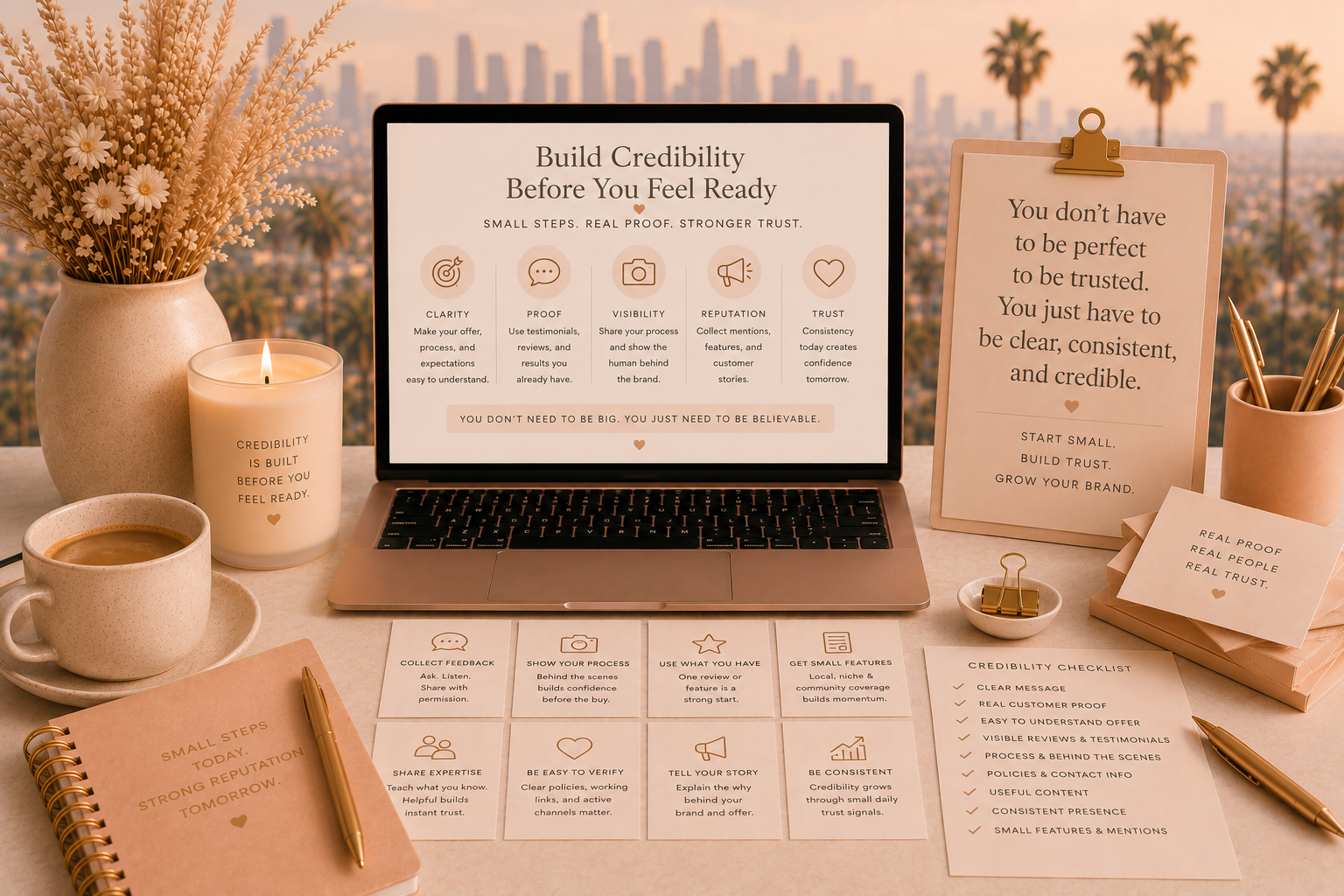
Small online brands do not need to wait until everything feels perfect to build credibility. Start with clear proof, real customer trust signals, useful content, and a more visible reputation.
Many small online brands wait too long to build credibility because they think credibility comes after the business looks more established.
They want a better website first. Better photos. More followers. More reviews. More products. A cleaner offer. A more polished brand identity. A bigger audience. A more impressive founder story. A launch that feels less homemade and more official.
Some of that makes sense. A brand should care about presentation. It should want the customer experience to feel thoughtful. It should want the website, product pages, service pages, and social presence to feel clear and trustworthy.
But credibility is not something a brand earns only after everything feels perfect.
Credibility is built while the business is growing.
For small online brands, this matters because customers are making trust decisions long before the business feels fully ready. They are looking at the website, the reviews, the founder, the product descriptions, the contact page, the policies, the social content, and the way the brand explains itself. They are asking whether this business feels real, reliable, and worth taking a chance on.
The brand does not need to look huge to answer that question well.
It needs to look clear, consistent, and credible.
Credibility Starts Before the Brand Feels Polished
A common mistake new entrepreneurs make is treating credibility like a future project.
They tell themselves they will ask for testimonials once the customer base is larger. They will pitch a local feature once the brand looks more impressive. They will add case studies once the service is more refined. They will talk about their process once they feel more confident. They will write clearer website copy once they have more time.
The problem is that customers are already forming opinions.
Even a small audience is still an audience. Even a first customer is still a customer. Even an early product page is still shaping trust. Waiting for a more perfect version of the business can leave the current version under-supported.
Credibility does not require pretending to be farther along than you are. It requires showing customers that the business is thoughtful, active, and capable right now.
Do Not Confuse Being New With Being Untrustworthy
A business can be new and still be credible.
Customers do not always need a brand to have ten years of history. They need enough reassurance to feel that the purchase, booking, or inquiry is not risky in a way they cannot understand.
A new brand can create that reassurance through clear communication. It can explain what it sells, who it serves, how the process works, what customers can expect, and how to get help. It can show real product details. It can share customer feedback as it comes in. It can make policies easy to find. It can respond to questions with care.
Those details are credibility signals.
They tell the customer that the business may be small, but it is not careless. It may be new, but it is not confusing. It may still be growing, but it has standards.
Start With Clarity
The fastest way for a small online brand to look more credible is to become easier to understand.
Customers should not have to guess what the business offers, how the product works, what is included, what happens after purchase, or how to contact the brand if they need help. Confusion makes a business feel less established than it may actually be.
Clear messaging creates the opposite effect.
A clear homepage tells visitors who the brand helps and what it offers. A clear product page answers practical buying questions. A clear service page explains the process. A clear FAQ reduces hesitation. A clear contact page tells customers when they can expect a reply.
Clarity is not glamorous, but it is powerful.
Small brands often worry about looking more polished when what they really need first is to look less confusing.
Use the Proof You Already Have
Many small brands think they do not have enough proof to show yet. But proof does not have to begin with a magazine feature, a celebrity customer, or hundreds of reviews.
Early proof can be simple.
A thoughtful testimonial from one customer. A screenshot of kind feedback, shared with permission. A before-and-after example. A product photo from a real buyer. A short case study from an early client. A behind-the-scenes look at the process. A clear explanation of why the product is made a certain way.
These details help customers see that something real is happening.
The key is to make proof visible. Do not leave every positive customer comment buried in direct messages. Do not hide every client result in private. Do not assume people will trust the offer just because the brand says it is good.
Use the proof you have, then keep building more.
Make Customer Feedback Easier to Collect
Credibility grows faster when the business has a simple habit for collecting feedback.
Many small brands wait passively for reviews and testimonials. Some customers will leave them without being asked, but many will not. They may have had a good experience and still move on with their day.
A small brand should make feedback easy.
After an order is delivered, send a short message asking for a review. After a service is completed, ask the client what changed or what they found most helpful. After a customer shares kind words, ask if you may use their comment as a testimonial. After a successful project, write a simple case study while the details are still fresh.
This does not need to feel pushy. It can be warm and straightforward.
Customer feedback is not only a nice extra. It is reputation material.
Show the Process Behind the Offer
Small brands can build credibility by showing how the work happens.
This is especially helpful for handmade sellers, artists, designers, consultants, service providers, and specialty product brands. Customers often trust the offer more when they understand the care, thought, or expertise behind it.
Show the materials. Show the research. Show the packing process. Show the design decisions. Show the quality checks. Show how a service moves from inquiry to delivery. Show what customers can expect after booking.
This kind of content works because it turns invisible effort into visible value.
A customer may not know why a product costs more, why a service takes time, or why a process matters until the brand explains it. Process content gives customers more reasons to trust the work before they buy it.
Build a Reputation Page Before You Think You Need One
A small brand does not need a long list of press features to start organizing credibility signals.
A simple reputation section can include testimonials, reviews, customer photos, small features, podcast appearances, collaborations, client results, founder credentials, or community mentions. It can start small and grow over time.
The point is not to exaggerate. The point is to collect trust signals in one place so customers do not have to search for them.
This can live on the homepage, an About page, a dedicated Press page, a Reviews page, or a small “As Seen In” section when appropriate. For service providers, it may appear as a results or client experience section.
Credibility becomes more useful when it is easy to find.
Use Founder Credibility Carefully
For small brands, the founder often plays a large role in trust.
That does not mean every founder needs to turn their personal life into content. It means customers may want to understand who is behind the business, why the business exists, and why this person is capable of delivering what they are promising.
Founder credibility can come from experience, taste, training, process, lived insight, professional background, customer understanding, or a clear point of view.
The mistake is making the founder story only about the founder.
A strong founder story connects back to the customer. It explains why the business exists in a way that helps people understand the value of the offer.
It should answer: Why this business? Why this approach? Why should the customer trust this person to solve this problem or create this product?
Pitch Smaller Opportunities First
Small online brands do not need to wait for major press to begin building visibility.
Start with smaller, realistic credibility opportunities. Local publications. Niche blogs. Small podcasts. Founder interviews. Gift guides. Community newsletters. Industry roundups. Collaboration posts. Expert quote opportunities. Alumni features. Customer spotlight stories.
These opportunities may not feel glamorous, but they can be valuable.
They give the brand something to point to. They help the founder practice explaining the story. They create search results. They provide content to share. They make the business feel more present in the world outside its own website.
Early credibility often builds in layers. One small feature can support the next one.
Make the Brand Easy to Verify
Credibility also comes from simple signs that the business is real and active.
Customers notice when the website feels current. They notice when social links work. They notice when policies are visible. They notice when the contact page explains response time. They notice when product pages include details instead of vague claims. They notice when reviews look recent. They notice when a brand has a consistent presence across platforms.
These are not flashy details. They are verification details.
A small brand can lose trust when customers encounter broken links, outdated announcements, missing contact information, old social feeds, unclear policies, or product pages that feel unfinished.
The business does not need to be everywhere. It needs the places it does show up to feel alive, aligned, and trustworthy.
Share Useful Expertise
One of the best ways to build credibility before a brand feels established is to teach what the business understands.
Useful content can build trust because it shows the brand has real knowledge, not just a product to sell. A skincare brand can explain ingredients. A handmade seller can explain materials and care. A consultant can explain common business mistakes. A designer can explain how clients should prepare for a project. A local service provider can explain what customers should know before booking.
This kind of content makes the brand feel more credible because it helps the customer make a better decision.
It also gives the business something more meaningful to say than “buy this.”
Do Not Overstate What You Have
There is a difference between building credibility and pretending to have more credibility than you do.
Small brands should be careful not to inflate minor mentions, overuse vague authority language, imply partnerships that do not exist, or make customer feedback look larger than it is. That kind of exaggeration can backfire because customers are very good at sensing when something feels padded.
Real credibility is stronger than exaggerated credibility.
If you have three strong testimonials, use them well. If you have one local feature, share it clearly. If you have a small but happy customer base, let that be real. If the founder has specific experience, explain it plainly.
Trust is not built by making the business look artificially inflated. It is built by making the real strengths easier to see.
Credibility Is a Habit, Not a Launch Moment
Small brands often imagine credibility as something that arrives through one big moment. One feature. One launch. One influencer mention. One viral post. One perfect review.
Those moments can help, but reputation usually grows through repetition.
A review here. A testimonial there. A clear product page. A helpful article. A small podcast interview. A thoughtful founder post. A collaboration. A customer photo. A local mention. A consistent response time. A better FAQ.
Over time, these signals begin to add up.
That is how small brands start to feel more established before they are widely known. Not because one signal does all the work, but because the customer sees enough evidence to feel comfortable trusting the business.
Start Before You Feel Ready
There may never be a perfect moment to start building credibility.
The website may always need one more improvement. The product page may always need another photo. The founder may always feel slightly uncomfortable asking for testimonials. The audience may always feel smaller than it should be.
But customers are already making trust decisions.
So start with what you have. Clarify the message. Collect feedback. Show the process. Add proof to the website. Make policies easier to find. Share useful expertise. Pitch small opportunities. Keep track of every mention, review, and customer story. Build the reputation while the business grows.
Credibility is not about pretending the brand has already arrived.
It is about giving customers enough real proof to believe it is worth following, buying from, and recommending as it grows.
Leave a Reply