
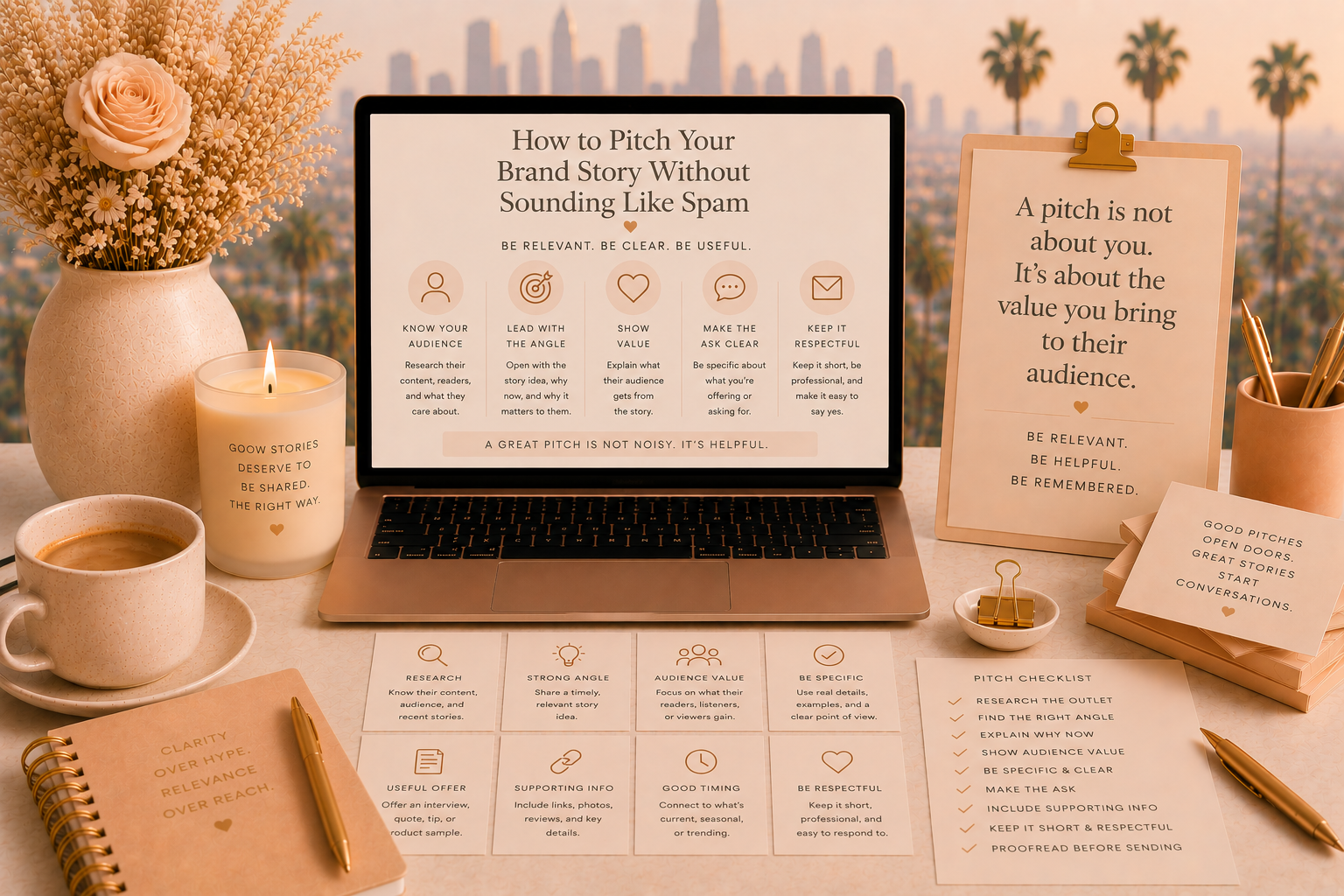
Small brands can pitch their stories without sounding generic or pushy by leading with relevance, clarity, audience value, and a reason the story matters now.
Pitching your brand can feel uncomfortable when you are still small.
You know the business matters. You know there is a story behind it. You know the product, service, or idea has value. But the moment you sit down to write an email to a journalist, podcaster, editor, newsletter writer, blogger, or potential collaborator, it can suddenly feel like you are asking for attention you have not earned yet.
That discomfort is one reason many small brands avoid pitching altogether.
The other reason is fear of sounding like spam.
Nobody wants to send the kind of message that feels generic, needy, overly promotional, or copied from a template that could have gone to five hundred people. Nobody wants to sound like they are shouting, “Please feature my brand,” without giving the other person a real reason to care.
The good news is that a strong pitch does not need to be loud, awkward, or pushy.
A good pitch is clear. It is relevant. It respects the person receiving it. It explains why the story matters to their audience, not just why the brand owner wants coverage.
That is the difference between a pitch that feels useful and a pitch that feels like spam.
A Pitch Is Not Just an Announcement
One of the biggest mistakes small brands make is treating a pitch like an announcement.
They write to say they launched a business, opened a shop, released a product, started offering a service, or created something they are excited about. That may be important to the founder, but it is not automatically a story for someone else’s audience.
A pitch needs more than news from inside the business. It needs relevance outside the business.
Why should this person’s readers, listeners, viewers, or followers care? What problem does the brand help solve? What trend does it connect to? What customer need does it reflect? What point of view does the founder bring? Why is this worth talking about now?
Those questions are what turn a simple announcement into a story.
“I launched a new online shop” is not very compelling on its own. “I launched a home goods shop because customers are looking for more personal, durable alternatives to mass-produced decor” gives the pitch more shape. It connects the brand to a customer behavior, a market shift, and a reason for interest.
Start With the Person You Are Pitching
A spammy pitch usually feels like the sender did not think about the recipient at all.
It could have gone to anyone. It uses vague praise, generic language, and no real connection to the recipient’s work. It asks for attention before showing why the story belongs in that person’s world.
A better pitch starts with fit.
Before sending anything, look at what the person actually covers. What kinds of stories do they publish? What audiences do they serve? What topics do they return to? What tone do they use? Do they cover founders, products, local businesses, consumer trends, creative entrepreneurs, service businesses, lifestyle brands, or industry insight?
Then pitch something that makes sense for them.
This does not mean writing a long paragraph about how much you admire their work. It means showing, briefly and specifically, that the pitch belongs in the conversation they already care about.
Relevance is the first form of respect.
Lead With the Angle, Not the Biography
Founder stories can be powerful, but many pitches put the founder biography too early.
The pitch begins with where the founder grew up, what inspired them, how long they dreamed of starting the business, and how passionate they are about the work. Those details may matter, but they are not always the strongest opening.
Start with the angle.
The angle is the reason the story is interesting to someone else. It might be a customer problem, a market trend, a local business story, a creative process, a timely shift, a useful lesson, or a fresh point of view.
For example, instead of opening with:
“My name is Olivia, and I started a candle company after years of loving fragrance and design.”
A stronger opening might be:
“As more customers look for calmer, more intentional home rituals, small fragrance brands are turning everyday products like candles into part of the wellness and design conversation.”
Now the brand has context. The founder can still appear in the pitch, but the story starts with why the audience might care.
Make the Story Specific
Generic pitches sound like spam because they could describe almost any business.
“We are passionate about quality.”
“We are changing the industry.”
“We offer unique products for modern customers.”
“We are excited to announce our launch.”
These lines are common, but they do not tell the reader much. They create a soft blur where the story should be.
Specificity makes a pitch stronger.
What kind of quality? What industry habit are you challenging? What customer problem are you solving? What makes the product or service different in practical terms? What is the founder’s actual point of view? What is the tension, change, or insight behind the business?
A small brand does not need to sound bigger than it is. It needs to sound more precise.
Explain Why Now
A good pitch often answers the question, “Why now?”
This is especially important when the brand is not yet widely known. The recipient may not have been waiting for your business to exist, so the pitch needs to connect the story to something timely, relevant, or useful.
Maybe the story connects to a seasonal moment. Maybe it fits a holiday gift guide. Maybe it reflects a customer behavior that is growing. Maybe it speaks to a local business trend. Maybe the founder has insight on a common mistake. Maybe the product is responding to a frustration in the market.
“Why now?” does not need to be dramatic. It just needs to create a reason for the story to be considered today instead of someday.
Without timing, a pitch can feel like a general request for attention. With timing, it feels more useful.
Show Audience Value
The recipient of a pitch is usually thinking about their audience.
Will readers learn something? Will listeners find this useful? Will viewers care? Will this fit the publication, podcast, newsletter, or platform? Will this story help the audience discover something interesting, solve a problem, understand a trend, or make a better decision?
Your pitch should help answer that.
Instead of focusing only on what the brand wants, explain what the audience gets.
For a product brand, the value might be discovery, usefulness, quality, design, gifting, local connection, or a better alternative to something common. For a service brand, the value might be insight, education, expertise, a useful framework, or a clearer way to understand a problem.
A strong pitch makes the recipient’s job easier by showing how the story serves their people.
Keep the Pitch Short Enough to Respect Their Time
A pitch does not need to explain the entire brand history.
It needs to create enough interest for the recipient to understand the angle, see the fit, and know what to do next. Long pitches often become weaker because the strongest point gets buried under too much background.
A useful structure is simple:
- Open with the story angle.
- Explain why it fits their audience.
- Introduce the brand or founder briefly.
- Offer a clear opportunity, such as an interview, quote, product sample, feature idea, or expert commentary.
- Close with an easy next step.
The goal is not to say everything. The goal is to make the next conversation easy.
Do Not Oversell the Brand
Small brands sometimes overcompensate in pitches because they worry they are not impressive enough yet.
They use inflated language. They call themselves revolutionary. They claim to be disrupting an industry. They make the launch sound much larger than it is. They describe ordinary details as if they are historic breakthroughs.
This usually has the opposite effect.
Credibility comes from clarity, not exaggeration.
If the business is new, it is fine to be new. If the feature is local, say it clearly. If the brand is growing, say what is actually gaining traction. If the founder has a specific perspective, explain it plainly. If the product solves a practical problem, show that problem honestly.
A pitch that feels grounded is often more trustworthy than one trying too hard to sound important.
Offer Something Useful, Not Just Access to Yourself
Many weak pitches ask for a feature without offering much value.
They say the founder is available for an interview, but they do not explain what the founder can actually speak about. They say the product is available for review, but they do not explain why the product fits the audience. They ask for coverage, but they do not offer a strong story, expert insight, data point, visual angle, customer trend, or useful example.
A stronger pitch offers something specific.
A founder can offer commentary on a trend. A designer can explain a common mistake. A handmade seller can talk about process, sourcing, or pricing. A service provider can share a framework. A product founder can explain what customers often misunderstand about the category.
Being available is not enough.
Be useful.
Make the Ask Clear
A recipient should not have to guess what you are asking for.
Are you pitching a feature? Offering yourself as a source? Suggesting a podcast interview? Asking to be considered for a gift guide? Offering product samples? Sharing a local business story? Suggesting expert commentary for an upcoming article?
Say it clearly.
A vague pitch creates extra work. A clear ask helps the recipient understand how to respond.
For example:
“I would be happy to share a few practical tips on how early-stage online sellers can use customer questions to improve their product pages.”
Or:
“If you are working on any holiday gift guides for small home brands, I would love to submit our ceramic desk collection for consideration.”
Or:
“I can provide a founder quote on how handmade sellers are using clearer policies to build buyer trust online.”
The clearer the ask, the easier it is to say yes, no, or maybe later.
Include the Right Supporting Details
A good pitch should include enough supporting information to help the recipient evaluate the story quickly.
This might include the brand website, a short founder bio, product or service details, high-quality images, customer proof, press links, review highlights, location, launch timing, availability, or relevant credentials.
Do not overload the email with attachments unless they were requested. A simple link to a press page, media kit, product page, or image folder can be cleaner.
The supporting details should answer the natural questions someone might have:
- What is the brand?
- Why does this story matter?
- Who is behind it?
- Why is it relevant to my audience?
- Where can I learn more?
- What are you offering or asking?
The easier you make it to understand, the stronger the pitch feels.
Personalize Without Performing
Personalization matters, but it should not feel forced.
A pitch does not need a long opening paragraph praising the recipient’s career, complimenting their writing style, or pretending you have been a lifelong fan if you have not. That kind of personalization can feel artificial.
Better personalization is simple and relevant.
Mention the section they write for, the kind of stories they cover, a recent topic that connects naturally to your pitch, or why your idea fits their audience. Keep it brief.
The point is not flattery. The point is fit.
A pitch feels less like spam when it is obvious the sender knows why they are sending it to this person.
Follow Up Without Becoming Annoying
Following up is normal. Chasing aggressively is not.
People are busy. Emails get missed. A polite follow-up can be helpful, especially if the pitch is timely. But repeated follow-ups with pressure, guilt, or dramatic urgency can damage the relationship before it begins.
A simple follow-up might say:
“I wanted to follow up in case this was a fit for any upcoming small business or founder story coverage. Happy to send more details if helpful.”
That is enough.
If there is still no response, move on. A no response is information too. The pitch may not have fit. The timing may have been wrong. The recipient may have been too busy. That does not mean the brand should stop pitching. It means the next pitch should be sharper, better targeted, or sent elsewhere.
Do Not Pitch Before the Basics Are Ready
You do not need a perfect brand before pitching, but the basics should be ready.
If someone likes the pitch and clicks through, the website should explain the business clearly. The product or service page should be understandable. Contact information should be easy to find. Images should be usable. Testimonials or proof should be visible if available. The brand should feel active, not abandoned.
A strong pitch can create interest. The rest of the brand experience needs to support that interest.
This is why PR and brand clarity work together. Pitching gets someone to look. Credibility helps them keep looking.
A Simple Pitch Framework
A small brand pitch can follow a simple structure:
Subject: Story idea: How small online brands are building trust before they feel established
Opening: I noticed you cover early-stage business and online brand growth, and I thought this might fit your audience.
Angle: Many new sellers wait to build credibility until they feel “ready,” but customers start making trust decisions from the first click. There is a useful story here about how small brands can use reviews, founder visibility, customer questions, and small press mentions to look more credible without pretending to be bigger than they are.
Why this brand or founder: I work with early-stage online brands on messaging, trust signals, and customer experience, and I can share practical examples of what helps customers feel safer before buying.
Offer: I would be happy to provide a few tips, a quote, or a short interview if this is useful for an upcoming piece.
Close: Thank you for considering it. I am happy to send more details if helpful.
This framework is not magic. It simply keeps the pitch focused on relevance, audience value, and a clear next step.
The Best Pitch Sounds Like a Clear Opportunity
A strong pitch does not beg for attention.
It presents a clear opportunity. It says, in effect, “Here is a story your audience may care about, here is why it matters, here is why I can contribute something useful, and here is the next step if it fits.”
That is not spam.
Spam is generic. Spam is self-centered. Spam ignores the recipient’s audience. Spam asks for coverage without offering a story. Spam uses inflated claims instead of real relevance.
A good pitch does the opposite.
It respects the person receiving it. It makes the story easy to understand. It connects the brand to a larger reason for interest. It offers something useful. It makes the ask clear.
Small brands do not need to wait until they are famous to pitch their stories. They simply need to pitch with clarity, relevance, and respect.
Because the goal is not to sound bigger than you are.
The goal is to sound worth talking about.
Leave a Reply