
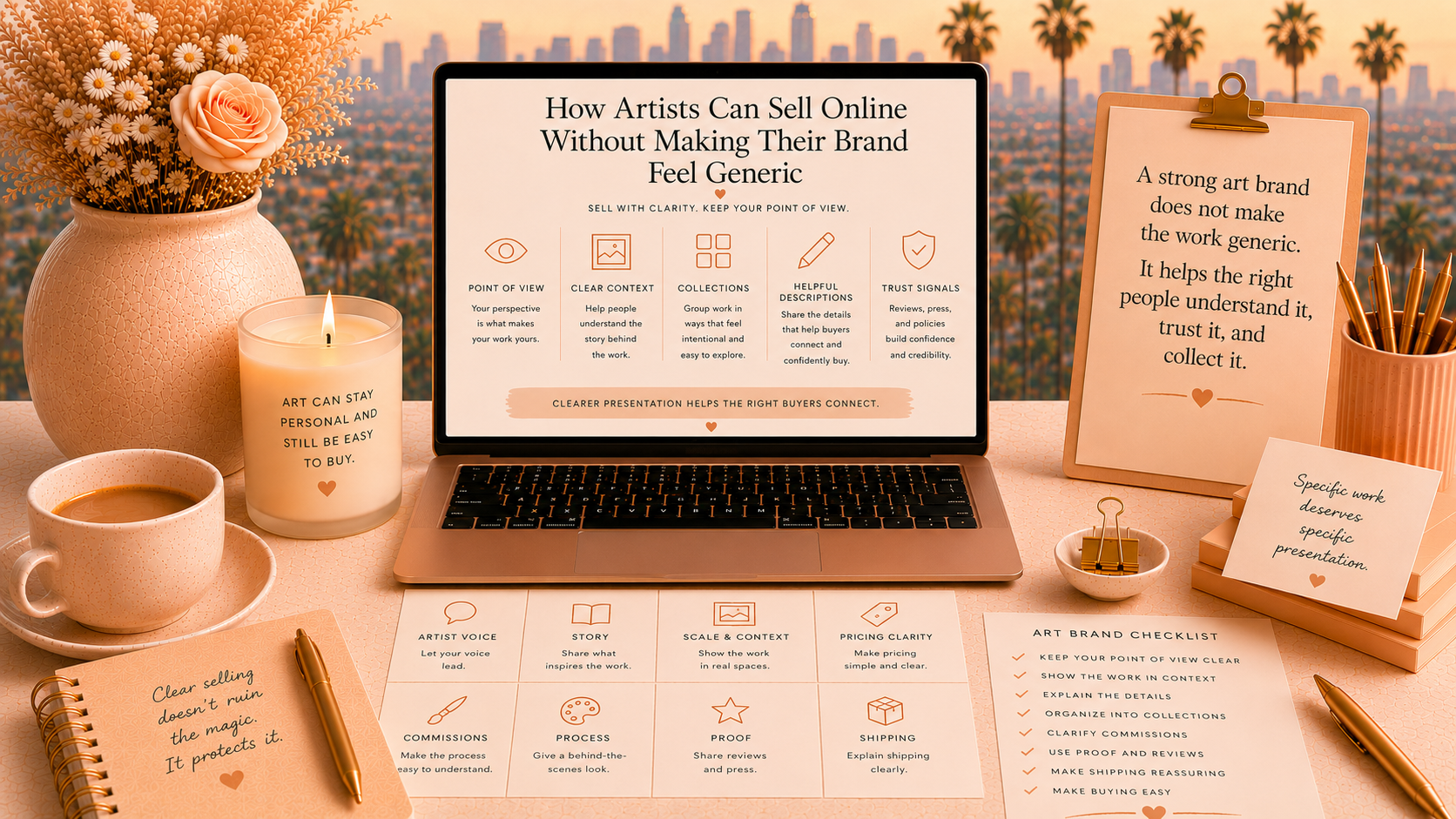
Artists can sell online without flattening their work into a generic brand by using clearer storytelling, stronger product pages, better context, and a buying experience that supports the art without watering it down.
Artists often worry that selling online will make their work feel less personal.
That fear makes sense. Art is not a basic commodity. It carries taste, perspective, memory, emotion, process, style, training, instinct, and lived experience. It may come from years of practice or from a very specific moment of inspiration. It may feel intimate to make and vulnerable to share.
So when artists hear advice about product descriptions, pricing structure, email lists, social content, customer questions, and conversion, it can sound like the work is being pushed into a generic online store template.
But selling online does not have to make an artist’s brand feel generic.
The problem is not selling. The problem is selling without context.
When an artist’s online presence does not explain the work clearly, customers are left with only the image, the price, and their own assumptions. That can make even meaningful work feel harder to buy. A stronger online brand gives the art more support. It helps people understand what they are seeing, why it matters, how to purchase it, and what kind of experience they can expect.
The goal is not to turn art into bland content.
The goal is to make the work easier to understand, trust, and collect without removing the voice that made it worth noticing in the first place.
Generic Happens When the Artist Hides the Point of View
A generic art brand usually does not feel generic because the work has no personality.
It feels generic because the presentation strips away the point of view.
The artist may use broad language like “beautiful art for your home,” “custom pieces for any space,” “unique designs,” or “original work made with love.” Those phrases are not wrong, but they do not tell the customer much. They could describe thousands of artists, makers, illustrators, print shops, and decor brands.
What makes the work specific?
Is it nostalgic, surreal, architectural, romantic, political, playful, minimal, maximal, spiritual, cultural, cinematic, handmade, experimental, sentimental, sharp, messy, refined, humorous, or deeply personal? Is it rooted in a place, memory, material, mood, discipline, technique, or recurring theme?
Artists do not need to overexplain every piece, but they should give customers enough language to understand the world the work comes from.
Point of view is what keeps the brand from becoming just another pretty shop.
Customers Need More Than “Original Art”
Originality matters, but it is not always enough to help someone buy.
A customer may like a piece and still wonder where it belongs, how large it is, what it feels like in person, what it is made from, whether it comes framed, how shipping works, whether prints are available, whether commissions are open, or why one piece costs more than another.
These questions do not make the customer less serious about art.
They make them human.
Online buyers are trying to make a decision without seeing the work in person. They need help understanding scale, texture, color, materials, finish, edition size, framing, care, shipping, and display. If the product page does not answer those questions, the customer may admire the art and still hesitate.
Good information does not cheapen the work.
It gives the customer enough confidence to bring the work into their life.
Tell the Story Behind the Work Without Turning Every Page Into an Essay
Storytelling is powerful for artists, but it needs balance.
A product page does not need to become a diary entry. Customers should not have to read a long personal essay before they understand what the piece is. At the same time, a cold listing with only a title, size, and price may not do enough to make the work feel meaningful.
The best approach is usually a short layer of context.
What inspired the piece? What is the mood? What does the collection explore? What material or process matters? What kind of space or collector might connect with it? What feeling does the work carry?
A few thoughtful sentences can give the customer a stronger relationship to the piece without overwhelming the buying experience.
The story should help the customer see the work more clearly.
It should not bury the work underneath the artist’s explanation.
Create Collections Instead of Random Listings
One way artists can make their online shops feel more intentional is by organizing work into collections.
A collection gives the customer a frame. It shows that the pieces are connected by a theme, mood, material, season, subject, technique, or idea. It also helps the artist avoid presenting every piece as a disconnected object with no larger context.
A collection can be simple.
It might be a group of prints inspired by a city. A series of paintings about domestic spaces. A set of illustrations based on childhood objects. A color study. A holiday drop. A limited release of small works. A commission style organized around a specific subject.
Collections make the brand feel more curated without making it feel corporate.
They also make it easier to market the work because the artist has something clearer to talk about than “new pieces are available.”
Use Product Descriptions That Respect the Work and Help the Buyer
An art product description should do two jobs at once.
It should respect the emotional and creative value of the work. It should also answer the practical questions a buyer needs answered before spending money.
A strong art listing might include:
- The title of the piece
- The medium or materials
- The size and orientation
- Whether it is original, a print, a limited edition, or made to order
- Whether it arrives framed or unframed
- Any important texture, finish, paper, canvas, or production details
- A short note on the inspiration, collection, or mood
- Shipping, handling, and care expectations
This kind of description does not make the art feel generic.
It makes the buying experience feel trustworthy.
Show the Work in Context
Art can be hard to buy online when the customer cannot picture scale.
A flat image of the work is important, but it may not be enough. Customers often need to see the piece in context. They want to understand how large it feels, how it looks on a wall, how the colors behave in a room, how a print looks framed, or how a small original might sit on a shelf, desk, or gallery wall.
Context images help.
Show the piece held by hand. Show it on a wall. Show it beside furniture or objects that provide scale. Show close-ups of texture. Show packaging if it matters. Show framed and unframed options if both are available. Show the print quality, paper edge, canvas depth, or finish.
These visuals do not reduce the work to decor.
They help the customer imagine owning it.
Do Not Let the Website Feel Like an Abandoned Portfolio
There is a difference between a portfolio and a shop.
A portfolio shows what the artist has made. A shop helps someone buy, commission, collect, or inquire with confidence.
Many artists have online spaces that feel more like archives than active businesses. The work may be beautiful, but the path to purchase is unclear. There may be no pricing, no availability status, no commission information, no shipping details, no FAQ, and no clear contact path.
That uncertainty creates hesitation.
If the goal is to sell, the website should make that possible without forcing the customer to guess. Available work should be clearly marked. Sold work should be labeled. Commission status should be obvious. Print options should be explained. Contact information should be easy to find. Response expectations should be clear.
A beautiful portfolio can create admiration.
A clear shop helps admiration become action.
Make Commissions Easier to Understand
Commissions can feel very personal, which is why they need clear structure.
A customer may love an artist’s work but feel unsure about how to request a custom piece. They may not know what the artist will or will not create, how pricing works, what the timeline is, how many revisions are included, whether a deposit is required, or what happens if the final piece is not what they imagined.
A commission guide can reduce that uncertainty.
It should explain what types of commissions are available, starting prices or price ranges, size options, timeline, deposit requirements, revision or approval stages, delivery method, usage rights if relevant, and how to submit an inquiry.
This does not make the commission less meaningful.
It makes the process safer for both the artist and the customer.
Pricing Should Feel Clear, Not Apologetic
Artists often feel pressure around pricing.
They may underprice because they are still building confidence. They may hide prices because they are afraid of judgment. They may overexplain because they want customers to understand the labor behind the work.
But pricing needs to feel calm and clear.
The customer should understand what affects the price: size, medium, time, edition, materials, framing, customization, complexity, licensing, or exclusivity. The artist does not need to apologize for the price or defend every hour spent making the work.
Clear pricing helps the work feel more professional.
It also protects the artist from turning every inquiry into an emotional negotiation.
Use Social Media to Deepen the Work, Not Flatten It
Social media can make artists feel pressured to simplify everything.
Post more. Trend more. Show your face more. Make faster content. Explain the work in one hook. Turn the process into a reel. Package the art into easy little moments for people to consume.
Some of that can be useful, but artists should be careful not to let the platform flatten the work.
Social content should deepen the customer’s relationship to the art. It can show process, materials, studio notes, collection themes, installation ideas, customer homes, packaging, sketchbook pages, inspirations, or short reflections on specific pieces.
The goal is not to make the art generic enough for the algorithm.
The goal is to help the right people understand the art faster and remember it longer.
Let the Artist’s Voice Stay Present
A brand can be clear without becoming bland.
Artists should not remove their voice in an attempt to sound professional. The artist’s language, mood, humor, softness, intensity, nostalgia, directness, or specificity may be part of what makes the work feel alive.
The key is to make the voice useful.
Use the artist’s voice to explain the collection. Use it to describe the emotional tone of a piece. Use it to help customers understand process, materials, and intention. Use it to make product pages feel human without making them confusing.
Professional does not have to mean sterile.
For artists, the strongest brand voice usually sounds like the work, just translated clearly enough for customers to follow.
Proof Helps Art Buyers Feel Safer
Buying art online can feel risky for new collectors.
They may wonder whether the colors will look like the photos, whether the piece will arrive safely, whether the print quality is strong, whether the artist is reliable, or whether they are making a good decision.
Proof helps.
Customer photos, collector testimonials, studio process content, packaging videos, reviews, press mentions, exhibition history, previous commissions, and photos of sold work can all help build trust.
Proof does not have to be flashy. A simple customer photo of a framed print in a real home can make the buying experience feel more believable. A short testimonial about a commission process can reassure the next person who is considering one.
Art is emotional, but online buying still needs trust signals.
Make Shipping and Handling Feel Reassuring
Shipping is one of the least romantic parts of selling art, but it matters.
Customers want to know the work will arrive safely. They want to understand how it will be packaged, when it will ship, whether tracking is included, and what happens if something arrives damaged.
This is especially important for originals, framed work, ceramics, delicate pieces, and higher-priced items.
Artists should explain shipping and handling clearly. If pieces are packed with protective materials, say that. If prints ship flat or rolled, say that. If originals require extra processing time, say that. If insurance or signature confirmation is included, explain it.
Shipping details may not feel creative, but they help protect the customer’s confidence.
Generic Brands Copy Trends. Specific Brands Build Worlds.
An artist’s online brand becomes stronger when it feels like a world, not just a shop.
That world can be quiet or bold. Minimal or layered. Personal or conceptual. Decorative or political. Soft or strange. Practical or dreamlike. What matters is that the work feels connected by a recognizable point of view.
Generic branding often happens when artists copy the same templates, captions, tones, and sales language everyone else is using. The work may be different, but the presentation starts to feel the same.
A specific brand builds its own language.
It has recurring themes. It has a visual rhythm. It has a way of explaining the work. It has a reason certain materials, subjects, colors, or ideas keep appearing. It gives customers something to remember beyond a single post.
That is what helps an artist stand out without needing to become louder or more generic.
Clear Selling Does Not Ruin the Magic
Some artists worry that explaining the buying details will ruin the feeling of the work.
But uncertainty ruins more sales than clarity does.
A customer can feel emotionally connected to a piece and still need to know the size, price, shipping timeline, framing status, and return policy. They can love the artist’s voice and still need a clear checkout path. They can appreciate the mystery of the work without wanting the buying process to feel mysterious too.
Clear selling does not remove the magic.
It protects the moment when someone decides to bring the work home.
Artists Can Sell Without Becoming Generic
Selling online does not require artists to flatten their work, copy every trend, or turn their brand into a bland lifestyle template.
It requires clearer context.
Explain the work. Show the scale. Share the process. Organize collections. Make commissions understandable. Use descriptions that carry both story and details. Clarify pricing. Show proof. Make shipping feel safe. Let the artist’s voice stay present.
The art can remain personal, expressive, and specific.
The business around it can still be clear, structured, and trustworthy.
That is the balance.
A strong online art brand does not make the artist generic.
It helps the right people understand why the work is worth collecting.
Leave a Reply