
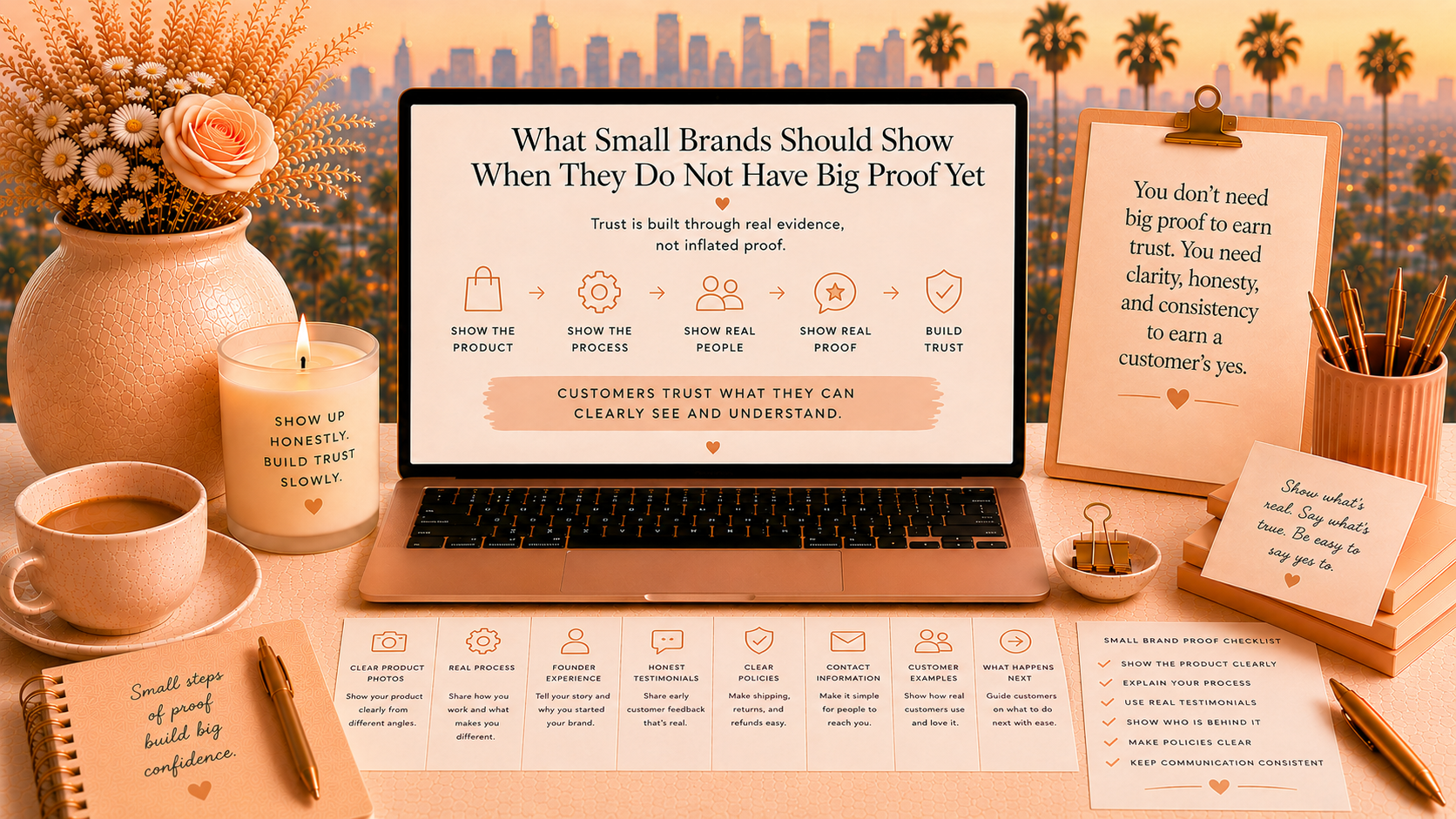
A newer business may not have hundreds of reviews, major press, or a long client list, but it can still give customers meaningful evidence that the offer, process, and people behind it are worth trusting.
Small brands often feel as if they are being asked to prove themselves with evidence they have not had enough time to collect.
Established companies can point to years of reviews, large customer counts, recognizable clients, press coverage, awards, and case studies. A newer business may have only a handful of customers, a small portfolio, limited media attention, and no impressive number to place beneath a headline.
That can create a frustrating cycle. Customers want proof before buying, but the business needs customers before it can accumulate more proof.
The solution is not to pretend the business is larger or more established than it is. It is to broaden the definition of proof.
Customers are not really looking for impressive numbers for their own sake. They are looking for evidence that the business is legitimate, competent, thoughtful, and likely to deliver what it promises. Reviews and customer counts can provide that reassurance, but so can clear product information, visible process, relevant experience, professional presentation, real examples, transparent policies, and evidence that actual people are responsible for the work.
A small brand may not have big proof yet. It can still show meaningful proof.
Proof Is Really About Reducing Uncertainty
When customers look for testimonials, reviews, client logos, or press mentions, they are trying to reduce risk.
They want reassurance that the business exists beyond its own marketing claims. They want to know whether the product looks as good in real life as it does in photographs, whether the service provider understands the work, whether orders actually arrive, and whether someone will respond if something goes wrong.
Big proof makes those questions easier to answer because it suggests that many people have already taken the risk.
Small businesses have to answer the same questions through other forms of evidence.
That means the real goal is not to make a young company look old. The goal is to help customers understand why this business deserves consideration now.
Start With the Proof You Already Have
Small businesses often underestimate the evidence they have because it does not look like a traditional testimonial carousel or a row of recognizable logos.
Proof can come from many places.
A business may already have:
- Photographs of completed work.
- Samples of products.
- A small number of genuine customer reviews.
- Testimonials from early buyers or clients.
- Relevant professional experience from before the business launched.
- Demonstrations of how a product works.
- Process photographs.
- Credentials or certifications.
- Before-and-after examples.
- Early sales or repeat purchases.
- Customer questions that reveal interest.
- Partnerships or collaborations.
- Press mentions, even from smaller publications.
- Founder expertise.
- Real examples of customer outcomes.
Each piece may seem modest individually, but together they can create a credible picture of the business.
The important thing is to present this evidence honestly and in context.
Show the Product Clearly
For product-based businesses, the product itself is one of the strongest forms of proof available.
Customers want to see what they are actually buying.
That means product photography should do more than create an attractive mood. It should help customers evaluate the item.
Useful visual proof may include:
- A clear primary product photograph.
- Multiple angles.
- Close-up images showing materials or construction.
- Photographs that demonstrate scale.
- Images of the product in use.
- Packaging when presentation matters.
- Variation examples when color, size, or finish differs.
- Production or craftsmanship details when relevant.
The more accurately customers can understand the product before purchasing, the less they have to rely on reputation alone.
A small brand may not have thousands of reviews confirming quality, but it can show quality carefully.
Show the Work, Not Just the Claim
Claims are easy to make.
Nearly every business can say that it offers high quality, exceptional service, careful craftsmanship, thoughtful design, or personalized attention. Those statements may be true, but they are stronger when the business provides evidence.
If the product is handmade, show part of the making process. If the service is highly organized, explain the process. If quality materials are important, identify them. If customer care is a strength, explain how communication works. If the business pays attention to detail, show the details.
Specificity gives customers something to evaluate.
Instead of saying, “We care about quality,” the business might show how products are inspected before shipping. Instead of saying, “We offer a personalized experience,” a service provider might explain how the initial consultation shapes the project.
Proof becomes more credible when the customer can see what the claim looks like in practice.
Use Founder Experience When It Is Relevant
A business may be new without the person behind it being inexperienced.
Founders often bring years of professional, creative, technical, retail, operational, or industry experience into a new venture. That background can provide legitimate credibility even when the company itself has a short history.
The key is relevance.
A useful About page or service page might explain:
- Previous professional experience.
- Relevant education or training.
- Industry background.
- Specialized skills.
- Past projects.
- Experience solving similar problems.
- Why the founder created the business.
- What knowledge shaped the offer.
This should not become an autobiography.
Customers generally need enough background to understand why the person behind the business is qualified to deliver what is being sold.
A new company can still be built by someone who knows what they are doing.
Use Small Testimonials Well
A business does not need dozens of testimonials before the first few become useful.
One specific testimonial can provide more meaningful evidence than ten generic ones.
The most helpful customer feedback often explains:
- What the customer purchased.
- What concern or need they had beforehand.
- What the experience was like.
- What they appreciated.
- What result they received.
- Whether they would purchase again or recommend the business.
These details help future customers see themselves in the experience.
If the business has only a small number of testimonials, use them where they matter most. A service testimonial may belong near the relevant service. A product review may be most useful beside the product itself. A comment about customer service may support the shipping or support section.
Placement can make limited proof work harder.
Show Early Customer Activity Without Inflating It
Small businesses sometimes feel pressure to make early traction sound larger than it really is.
That is unnecessary and risky.
If the business has served 27 customers, there is nothing wrong with saying so if the number is relevant. If five customers have reordered, that may be meaningful. If a product sold out of its first small batch, that can be useful evidence.
The point is accuracy.
A small but real number is more trustworthy than vague language designed to imply a much larger audience.
Useful early indicators might include:
- First-batch sellouts.
- Repeat orders.
- Returning clients.
- Waitlist growth.
- Customer referrals.
- A growing subscriber list.
- Local event participation.
- Wholesale placements.
- Early partnerships.
- Consistent product demand.
These signals should be presented carefully and without exaggeration.
Customers do not necessarily expect a young business to have huge numbers. They do expect the numbers it uses to be real.
Show the Process
Process is especially valuable when the customer cannot yet rely heavily on reputation.
Seeing how the business works reduces mystery.
For a product company, this might include how orders are made, packed, checked, or fulfilled. For a service provider, it might include the stages between inquiry and completion.
A clear process can show:
- What happens after the customer orders or books.
- How the business prepares the work.
- Where quality checks occur.
- When communication happens.
- What the customer is expected to provide.
- How delivery or completion works.
- What support exists afterward.
This is proof because it demonstrates preparedness.
The customer can see that there is a system behind the offer rather than simply a promise.
Show the Standards Behind the Business
Customers often trust a brand more when they understand how decisions are made.
A business may have standards around materials, suppliers, sourcing, production, customer service, design, fulfillment, or who it agrees to work with.
Those standards can become useful evidence.
For example, a retailer might explain how products are selected. A maker might discuss material choices. A consultant might explain the criteria used before recommending a strategy. A food business might show sourcing and handling standards.
This information helps the customer understand what the brand means when it uses words such as quality, thoughtful, sustainable, premium, careful, or personalized.
Standards turn abstract brand language into something observable.
Show Clear Policies
Policies may not look like proof, but they tell customers something important about the business.
They demonstrate that the company has considered what happens after the purchase.
A clear shipping policy shows that fulfillment has been thought through. A clear return policy explains how problems will be handled. A cancellation policy sets expectations for a service relationship. Transparent payment terms reduce uncertainty before a commitment.
For a small brand without a large reputation, this matters.
Customers may not know whether the business has handled thousands of transactions, but they can see whether it appears prepared to handle theirs.
Show Real Contact Information
One of the simplest trust signals is evidence that the business can actually be reached.
Customers do not necessarily need access to the founder’s personal phone number or private information. They do need a legitimate way to communicate with the company.
Useful signals include:
- A business email address.
- A working contact form.
- Customer service information.
- Expected response times.
- A business location when relevant.
- Active social profiles.
- Clear instructions for order-related support.
The existence of an accessible communication channel reduces the fear that the customer will disappear into a website after payment with no way to reach anyone.
This is especially important for unfamiliar brands.
Show Consistency Across the Customer Experience
Consistency is proof because it suggests the business is being managed deliberately.
Customers notice when the website, social media, emails, checkout experience, and customer service all feel connected.
They also notice when information conflicts.
If social media promotes one price while the website shows another, confidence falls. If shipping information differs between the product page and FAQ, customers become uncertain. If the brand looks polished publicly but confirmation emails feel unfinished, the experience becomes less predictable.
Consistency should extend across:
- Brand name and identity.
- Product descriptions.
- Pricing.
- Policies.
- Contact information.
- Customer service expectations.
- Visual presentation.
- Tone of communication.
- Fulfillment information.
A coherent business feels more established because customers can predict what they are dealing with.
Show What Happens After the Purchase
Customers often evaluate a business partly by what they expect will happen after they pay.
A newer brand can build trust by making that process visible before the transaction occurs.
Explain whether customers will receive:
- An order confirmation.
- A booking confirmation.
- Shipping updates.
- Tracking.
- Production updates.
- Appointment instructions.
- Project milestones.
- Delivery information.
- Follow-up support.
This demonstrates that the customer journey continues beyond checkout.
It also makes the purchase feel less risky because the customer can imagine what happens next.
Use Case Studies Even When They Are Small
A case study does not need to involve a multinational company or a dramatic transformation.
For a small business, a simple case study can show how the offer works in a real situation.
A useful case study might explain:
- Who the customer was in general terms.
- What they needed.
- What the business provided.
- How the process worked.
- What the result was.
- What the experience demonstrates about the offer.
For product businesses, this could take the form of a customer story showing how the product was used. For service businesses, it may involve a completed project.
One well-documented example can help customers understand the offer more clearly than several paragraphs of general sales language.
Borrowed Credibility Should Be Used Carefully
Partnerships, media mentions, professional associations, retail placements, certifications, and collaborations can strengthen credibility because they show that another organization has interacted with or evaluated the business.
However, these signals should be used accurately.
A small mention should not be presented as if it were a major feature. A client relationship should not be implied when the connection was something else. Logos should not be used without permission where permission is required.
Credibility loses value very quickly when customers feel it has been inflated.
Use the proof you earned for exactly what it is.
That is enough.
Do Not Use Fake Social Proof
The pressure to look established can lead businesses toward shortcuts that damage trust rather than build it.
Fake reviews, purchased followers, invented testimonials, inflated customer counts, fabricated case studies, or misleading claims about popularity may create a stronger first impression temporarily.
They also introduce a much larger credibility risk.
A business that has little proof can explain that it is new. A business caught inventing proof has to explain why customers should believe anything else it says.
Small numbers are not embarrassing.
Dishonest numbers are.
Customers often respond positively to businesses that are clearly building something and willing to show the process honestly.
Make the Business Itself the Evidence
When a small brand does not yet have a large volume of external proof, the quality of the customer experience becomes even more important.
The website should work. Information should be accurate. Emails should arrive. Questions should receive responses. Policies should make sense. Orders should be fulfilled as promised.
Every interaction becomes evidence.
This means a newer business can build trust by being unusually good at the fundamentals:
- Explain the offer clearly.
- Use accurate photographs.
- Answer common questions.
- Set realistic expectations.
- Communicate when something changes.
- Fulfill what was promised.
- Make support easy to access.
- Follow up when appropriate.
These actions create the proof that eventually becomes reviews, testimonials, referrals, and repeat business.
Big proof is usually the result of many small moments handled well.
A Small-Brand Proof Audit
A business that feels short on social proof can review what it is already showing.
Ask:
- Can customers see the product or work clearly?
- Are we demonstrating the process behind what we sell?
- Are relevant founder qualifications or experience visible?
- Are genuine testimonials being used where they matter?
- Do we have early customer results or repeat activity worth showing?
- Are our standards and methods specific?
- Are policies easy to find?
- Is contact information legitimate and accessible?
- Is information consistent across channels?
- Do customers understand what happens after purchase?
- Do we have case studies or real examples we could document?
- Are we relying too heavily on claims that could be replaced with evidence?
This kind of audit often reveals that the business has more proof than it realized.
The problem may simply be that the evidence has not been organized around the questions customers are trying to answer.
The Vibe Check
Small brands do not need to pretend they already have the proof of an established company.
They need to show the proof they actually have.
Show the product. Show the process. Show the people. Show the standards. Show the experience behind the work. Use the genuine testimonials and customer examples available today. Make policies clear, communication easy, and expectations realistic.
Then keep delivering.
The impressive review count, larger portfolio, stronger case studies, and recognizable customer list can come later.
Trust does not begin when the business finally has enough logos to fill a homepage.
It begins when customers can look at what is already there and find real reasons to believe you will do what you say you will do.
Leave a Reply