
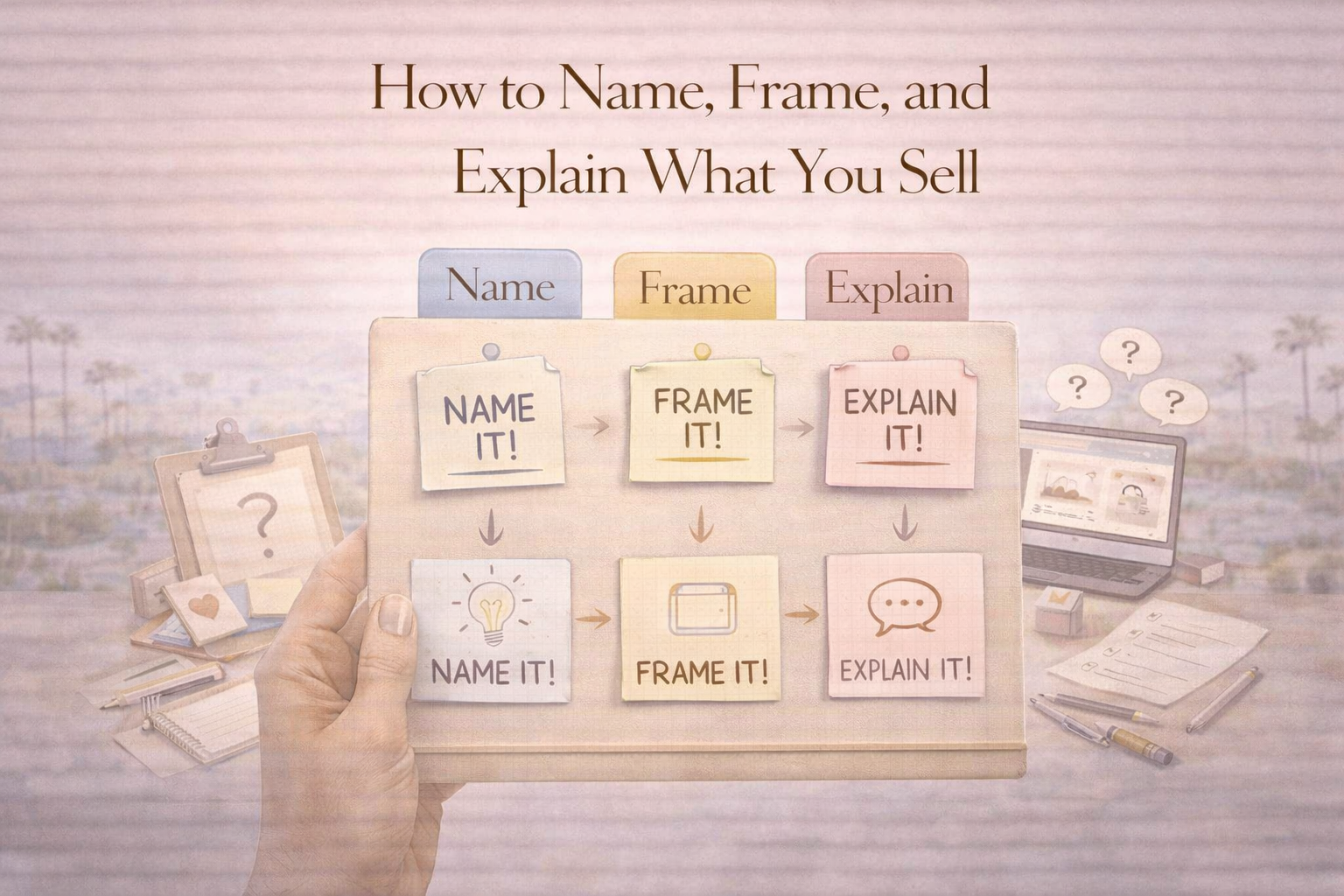
A lot of small brands do not have a product problem.
They have a language problem.
The thing they sell may be good. The offer may be useful. The quality may be there. The founder may know exactly why it matters.
But the way the business names it, frames it, and explains it often makes the whole thing harder to understand than it needs to be.
That matters because customers are not standing around waiting to decode your intent. They are scanning quickly, comparing options, reducing uncertainty, and trying to decide whether this business feels relevant enough and clear enough to keep their attention.
If what you sell is hard to place, it becomes hard to prefer.
That is why naming, framing, and explanation matter so much. They are not just copy details. They shape whether the offer lands at all.
Naming is about recognition, not cleverness.
A lot of founders get stuck here because they want the product or service name to sound original, elevated, and unlike anything else in the market.
I get the instinct.
The problem is that buyers usually need recognition before they need poetry.
If the name is too vague, too precious, too abstract, or too internally meaningful, the customer has to do more interpretive work than they should. That slows everything down.
A strong name should help the right buyer understand what category they are in, what kind of offer this is, or what kind of outcome they should expect. It does not have to be boring. It does need to be usable.
That means the real test is not, “Does this sound cool?”
It is, “Does this help the customer get oriented faster?”
Framing decides what the customer notices first.
This is where a lot of brands quietly lose the plot.
Even when the product or service name is fine, the framing around it can still be weak. The brand introduces the offer through the wrong angle, leads with the wrong detail, or emphasizes something that matters more to the founder than to the buyer.
Framing is not just wording. It is priority.
Are you presenting this as a premium object, a practical solution, a thoughtful upgrade, a time-saver, a status signal, a healthier alternative, a simpler process, a more personalized service, a creative collaboration, or something else entirely?
The way you frame what you sell teaches the customer how to think about it.
If the frame is weak, random, or overly broad, the offer starts feeling less distinct even if the thing itself is good.
Explanation should remove effort, not add atmosphere.
This is the part I think a lot of visually driven and taste-driven brands get wrong.
They explain the offer in language that sounds nice but does not actually make the decision easier.
The page is full of tone, but light on clarity.
The wording is elevated, but the buyer still does not know exactly what they are getting.
The copy is polished, but it has not answered the practical question underneath it all: why should I buy this from you instead of the obvious alternative?
Good explanation reduces labor for the buyer.
It answers the obvious questions quickly enough that the person on the other side does not have to keep translating your brand into plain English in their own head.
Most businesses explain from the inside out.
This is one of the biggest reasons offers get muddy.
Founders usually know too much. They know the story, the backstory, the nuance, the materials, the process, the problem, the aspiration, and all the decisions that led to the current version of the business.
So when they explain what they sell, they often do it from the inside out.
They start where their own relationship to the product starts, not where the buyer’s understanding starts.
The customer does not need the full internal journey first. They need orientation first.
What is this?
Who is it for?
Why does it matter?
Why this version?
What kind of result or experience should I expect?
If those answers come too late, the explanation is not doing its job.
Specificity usually beats breadth.
A lot of brands stay vague because they are afraid of narrowing the appeal.
So instead of saying something clear, they say something broad enough to apply to almost anyone.
They offer “thoughtful essentials.”
They create “elevated goods for everyday living.”
They provide “creative solutions for modern brands.”
They help businesses “show up authentically.”
None of those phrases are technically wrong. They are just too soft to do much work.
Specificity gives buyers something to hold onto.
It is easier to trust a business that sounds like it knows exactly what it does than one that keeps orbiting the point.
Broadness can feel safe to the founder, but it often feels forgettable to the customer.
The customer is usually trying to answer one silent question
Can I place this fast enough to care about it?
That is the real naming and framing test.
If someone lands on your site, sees your product, reads your service page, or hears you describe what you do, can they mentally place it in a useful way without struggling?
That does not mean reducing the offer until it sounds generic. It means making the front door clearer.
Once a customer can place the offer, they can start deciding whether it fits them.
If they cannot place it, the rest of the sales process starts wobbling immediately.
A good offer explanation does three things fast.
It tells me what this is.
It tells me why it matters.
It tells me why this version is worth considering.
That is really the core of it.
You can build more nuance around that. You can add tone, style, story, voice, and personality around that. But if those three pieces are weak, the whole explanation usually feels softer than it should.
This is especially important for:
- handmade products
- creative services
- premium goods
- new brands with little existing recognition
- offers that are not instantly self-explanatory
In those categories, language is doing even more of the trust-building work.
Bad naming makes good framing harder.
If the product or service has a weak name, the rest of the business often has to work harder to compensate.
A confusing product title forces the description to over-explain.
A vague service name forces the homepage to do more interpretive labor.
An overly clever category label makes the navigation less useful.
A made-up term with no clear relevance can make the whole site feel slightly more self-involved than it should.
This is why I usually prefer names that carry some kind of signal, even if that signal is subtle.
The name does not have to explain everything. It should not create unnecessary confusion before the explanation even starts.
Good framing can make a simpler offer feel stronger.
This is the upside.
You do not need an overly complex or revolutionary product for the framing to be effective. Sometimes the strongest businesses are selling something fairly straightforward but presenting it through a sharper, more useful angle.
The product is not just water. It is cleaner routine, better taste, better packaging, less plastic clutter, easier delivery.
The candle is not just a candle. It is a better-made home object with a specific scent logic, burn quality, and giftable identity.
The design service is not just design. It is clearer brand presentation for founders who are tired of looking smaller than they are.
That is what framing does. It tells the customer what kind of value to notice.
If people keep asking “Wait, what exactly do you do?” believe them.
This is one of the best signals you can get.
If prospects regularly misunderstand what you sell, if customers need extra explanation before they buy, if referrals come in half-confused, or if people compliment the brand but still do not seem to know what the offer actually is, that is not random.
That usually means the naming, framing, or explanation is doing less work than it should.
A lot of founders hear that kind of feedback and decide they need more marketing.
Sometimes they do.
Often they need a clearer sentence first.
What I would fix first
If I were helping a brand clean this up, I would start here:
- Rewrite the offer in one plain sentence without brand jargon.
- Pressure-test the product or service names for clarity, not just personality.
- Lead with the buyer-relevant angle instead of the founder-preferred angle.
- Cut abstract phrases that sound polished but say very little.
- Make sure the explanation answers what it is, who it is for, and why this version matters.
- Use customer language wherever possible instead of internal language.
Most businesses do not need to sound smarter. They need to sound clearer.
The bottom line
How you name, frame, and explain what you sell shapes whether people understand it fast enough to care.
That is why this matters.
A weak offer explanation can make a good business feel vague.
A stronger one can make the exact same business feel more specific, more valuable, and easier to trust.
Not because the product changed.
Because the language finally started doing its job.
Leave a Reply