
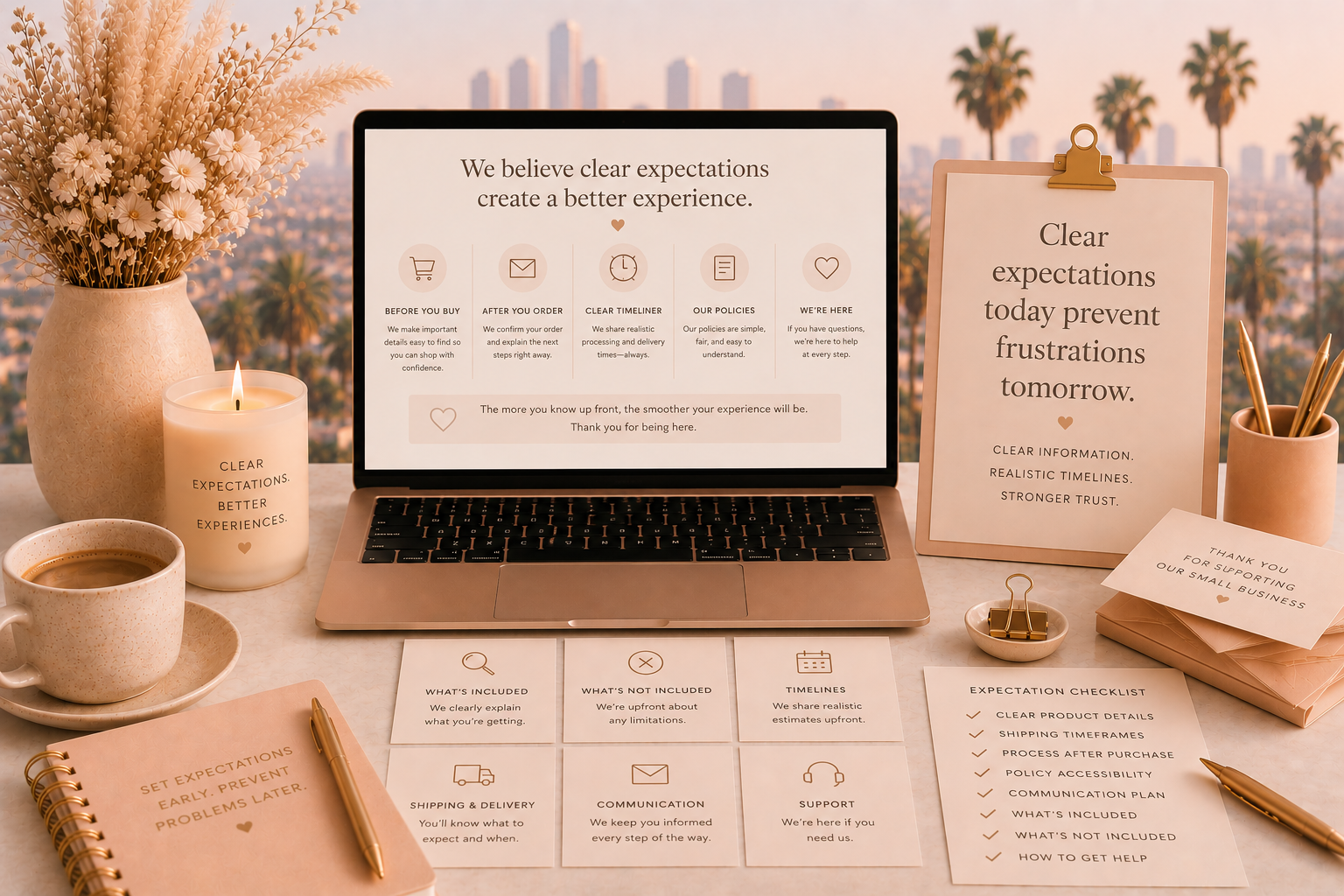
Clear expectations help small brands reduce complaints, build trust, and create a smoother customer experience before confusion turns into a support issue.
Many customer service problems begin before the customer ever sends a message.
They begin on the product page that does not explain the shipping timeline. They begin in the service description that sounds polished but does not say what is included. They begin in the checkout flow that confirms the order but does not explain what happens next. They begin in the policy page that technically exists, but is written so vaguely that nobody understands it until there is a problem.
By the time the customer reaches out, the issue may look like a complaint, a refund request, a shipping question, or a frustrated message. But underneath the surface, the real problem is often expectation-setting.
The customer expected one thing. The business meant another. The space between those two things is where trust gets strained.
Small brands can prevent many of these problems by setting expectations earlier, more clearly, and closer to the places where customers make decisions.
Customers Do Not Know What You Know
One of the easiest mistakes for a business owner to make is assuming customers understand the process.
From inside the business, everything feels obvious. You know how long orders usually take. You know what custom work includes. You know why a service has a certain timeline. You know what happens after checkout, booking, or inquiry. You know what information a customer needs to send before you can help.
The customer does not know any of that unless you tell them.
They are seeing the business from the outside. They are trying to piece together the experience from your website, your product descriptions, your emails, your policies, and your replies. If those pieces are incomplete, they will fill in the blanks themselves.
That is where problems begin.
Expectation-setting is not about explaining every tiny detail. It is about giving customers the information they need to feel oriented, confident, and realistic before emotion enters the conversation.
Expectation Gaps Create Friction
A customer who expects a package to ship tomorrow will feel frustrated if it ships in five business days, even if five business days is completely reasonable for the business.
A client who expects revisions to be included will feel disappointed if revisions are billed separately, even if that was always the business model.
A buyer who assumes returns are available will feel misled if the product is final sale, even if the policy exists somewhere on the website.
The issue is not always that the business did something wrong. Sometimes the issue is that the expectation was not clear enough at the right moment.
Customers do not judge the experience only by what is technically true. They judge it by what they believed would happen.
That belief is shaped by your communication.
Set Expectations Before the Purchase
The best time to prevent a customer service problem is before the customer buys.
Product pages and service pages should answer the questions that affect confidence. How long does this take? What is included? What is not included? What happens after checkout or booking? Are returns available? When will the customer receive tracking? What should they prepare? What are the limits of the offer?
This does not mean every page needs to become long or cluttered. It means the most important expectations should be visible before the customer commits.
If shipping takes three to five business days, say that near the buying point. If custom items are final sale, say that before checkout. If a service includes one revision but not unlimited revisions, say that on the service page. If a consultation requires prep materials, explain that before the client books.
Clear expectations do not scare away the right customers. They help the right customers buy with confidence.
Set Expectations Immediately After the Purchase
The moment after purchase is one of the most important trust moments in the customer experience.
The customer has already paid. Now they want reassurance that the business has the order, understands the next step, and will communicate if something changes.
This is why confirmation emails matter so much.
A good confirmation email should not only say thank you. It should explain what happens next. It should confirm the order or booking. It should state the processing timeline. It should tell the customer when tracking or next-step details will arrive. It should explain how to contact the business if something is wrong.
That kind of email reduces unnecessary support messages because it answers the first wave of post-purchase uncertainty.
It also makes the customer feel like the business is organized, which is exactly what they want to feel after spending money.
Use Plain Language Around Timelines
Timelines are one of the most common sources of customer frustration.
Small brands often use soft phrases like “ships soon,” “quick turnaround,” “fast processing,” or “we will be in touch shortly.” Those phrases may sound friendly, but they do not create clear expectations.
Customers need real timeframes.
“Ships within three to five business days” is stronger than “ships soon.”
“You will receive a reply within one business day” is stronger than “we will get back to you shortly.”
“The first draft is delivered within seven business days after we receive your materials” is stronger than “turnaround is about a week.”
Specific timelines make the business feel more professional because they give customers something concrete to understand.
Explain What Is Not Included
One of the most useful expectation-setting habits is explaining what is not included.
Many small businesses are comfortable describing the benefits of an offer, but less comfortable describing the limits. They worry that naming the limits will make the offer less appealing.
In reality, clear limits often build more trust.
If a service does not include implementation, say so. If a product does not come with accessories, say so. If a package includes one round of revisions but not ongoing support, say so. If a digital download does not include customization, say so.
Customers are more likely to become frustrated when they discover a limit after they have already paid.
A clear boundary before purchase feels professional. A surprise boundary after purchase feels like a problem.
Make Policies Easy to Find and Easy to Understand
Policies are one of the strongest expectation-setting tools a small business has.
Refund policies, return windows, cancellation rules, shipping timelines, response times, and service terms should be easy to find before the customer needs them. They should also be written in language a normal customer can understand.
A policy that technically exists but is hidden, vague, or written like legal filler does not do enough to build trust.
Good policies should answer practical questions:
- Can this be returned?
- How long does the customer have?
- What condition does the item need to be in?
- Who pays for return shipping?
- How long does a refund take?
- What happens if the item arrives damaged?
- How quickly does the business respond?
The clearer the policy, the less room there is for surprise later.
Repeat Important Expectations in More Than One Place
Customers do not read websites the way business owners hope they do.
They skim. They compare. They jump between pages. They miss details. They open links on their phones while doing three other things. That is normal.
Important expectations should not appear only once in a hidden corner of the site.
If something truly matters, repeat it where it matters. Put shipping timelines on the product page, in the FAQ, and in the confirmation email. Put service timelines on the service page, inquiry form, and onboarding message. Put return basics near checkout and link to the full policy.
This is not repetition for its own sake. It is customer guidance.
The goal is to make sure the customer sees the information before it becomes a problem.
Update Expectations When Something Changes
Even clear expectations need to be updated when reality changes.
If shipping is delayed, say so. If order volume is higher than usual, update the timeline. If a service calendar is booked farther out than normal, make that clear before someone inquires. If holiday processing takes longer, add the notice before customers start asking.
Customers are often more patient when they are informed early.
What frustrates them is discovering the change only after they have waited, wondered, and reached out first.
A proactive update protects trust because it shows that the business is paying attention. It tells the customer, “We know this affects your experience, and we are not leaving you to guess.”
Expectation-Setting Makes Customer Service Easier
Clear expectations help customers, but they also protect the business owner’s time.
When customers understand the process, they send fewer basic questions. When timelines are clear, they are less likely to ask for updates too early. When policies are easy to find, fewer conversations begin with confusion. When service scope is clear, fewer clients expect work that was never included.
This does not eliminate customer service. It improves it.
Instead of spending energy answering the same preventable questions, the business owner can focus on the issues that truly need attention.
For small brands without a large support team, that matters. Clarity is not only a customer experience tool. It is an operations tool.
Customers Feel Safer When They Know the Process
People trust businesses that make the next step obvious.
When customers know what happens after they order, they feel calmer. When they know when to expect a reply, they feel less ignored. When they know how a problem will be handled, they feel less anxious. When they understand the limits of the offer, they feel less misled.
This is the emotional value of expectation-setting.
It makes the customer feel guided.
A small business does not need to look huge to create that feeling. It needs to communicate clearly enough that the customer does not feel alone inside the process.
Clear Expectations Build Better Relationships
Expectation-setting is not about lowering the customer’s excitement. It is about protecting the relationship from avoidable disappointment.
Customers can handle real timelines. They can handle boundaries. They can handle policies. They can handle a business saying, “This is how the process works.”
What they struggle with is confusion after they have already trusted the brand.
For small businesses, this is one of the simplest ways to build a stronger customer experience. Say what happens. Say when it happens. Say what is included. Say what is not included. Say where to go for help. Then follow through.
That is not overexplaining.
That is making the business easier to trust.
Leave a Reply