
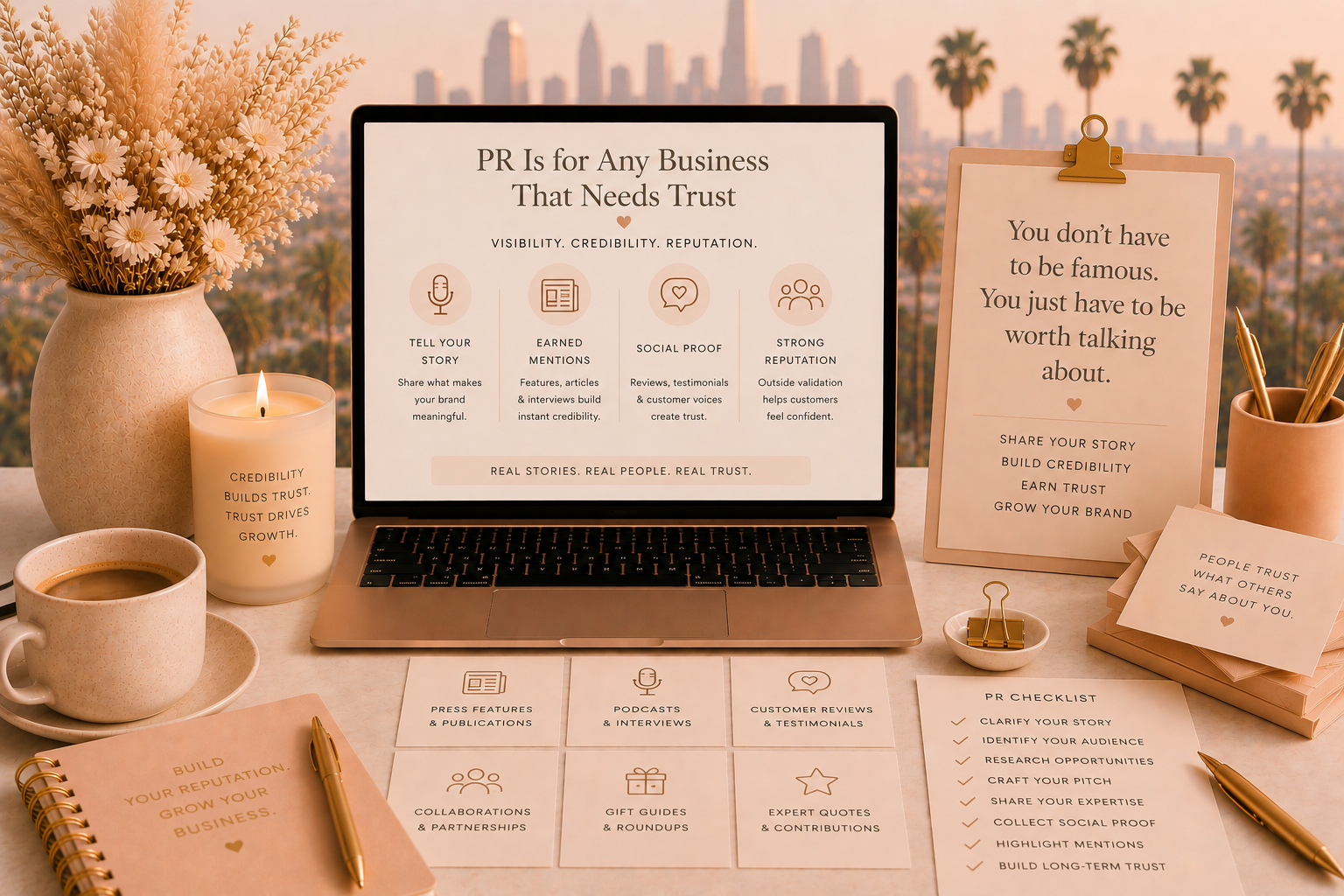
PR is not only for large companies. Small brands can use visibility, credibility, press, reviews, and reputation signals to build trust before customers buy.
Many small business owners hear the word PR and immediately picture something that feels too big for them.
They imagine national magazines, television interviews, celebrity founders, product launches with gift bags, publicists with expensive retainers, and brands that already have enough momentum to make the media care. PR starts to feel like a luxury reserved for companies with big budgets and polished teams.
That is why so many small brands ignore it.
But PR is not just for big brands. It is for any business that needs trust.
At its core, public relations is not about looking famous. It is about building credibility in places the brand does not fully control. It is the difference between a business saying, “We are trustworthy,” and the outside world giving customers reasons to believe it.
For a small brand, that can matter even more than it does for a large one.
PR Is Really About Borrowed Trust
Customers are naturally cautious with businesses they do not know yet. They may like the website, the product, the service, the photography, or the overall feel of the brand. But before they buy, they are still asking quiet questions.
Is this real? Is this business reliable? Do other people trust it? Has anyone talked about it? Are there reviews? Has it been featured anywhere? Does the founder know what they are doing? Will this brand still be here if I need help later?
PR helps answer those questions by creating borrowed trust.
When a brand is mentioned in a local publication, featured on a podcast, quoted in an article, reviewed by a customer, recommended by a creator, or included in a gift guide, it gains a small piece of outside validation. That validation tells future customers, “Other people have noticed this too.”
That is powerful because customers rarely trust a brand only because the brand tells them to. They trust patterns. They trust proof. They trust signals from people, platforms, and communities that are not the brand itself.
Small Brands Need Credibility Earlier Than They Think
Many entrepreneurs wait to think about PR until they feel more established. They tell themselves they will start pitching once the website is perfect, the audience is bigger, the product line is fuller, the service is more refined, or the brand looks more impressive.
There is logic in wanting to be ready. But waiting too long can become its own problem.
Credibility is not something a brand magically receives after it grows. Credibility is often part of what helps the brand grow.
A small business does not need national attention to begin building a reputation. It can start with local visibility, niche podcasts, customer testimonials, thoughtful collaborations, small publication mentions, community newsletters, founder quotes, expert commentary, and well-placed social proof.
These early signals help customers feel safer before the business has years of history behind it.
For newer brands, credibility is not decoration. It is part of the buying environment.
PR Does Not Have to Mean a Major Media Feature
One of the biggest misunderstandings about PR is that it only counts if the feature is large, glamorous, or nationally recognized.
That is not true.
For a small brand, the most useful credibility signals are often much more practical. A feature in a local business publication can matter. A mention in an industry newsletter can matter. A podcast interview can matter. A thoughtful customer testimonial can matter. A collaboration with a respected small brand can matter. A quote in an article can matter.
The question is not always, “How famous is this outlet?”
The better question is, “Will this help the right customer trust the brand?”
A niche feature in front of the right audience can be more valuable than a broad mention that brings attention but no real confidence. PR should support the brand’s actual business goals, not just the founder’s desire to feel visible.
Visibility Without Trust Is Not Enough
Small brands often confuse visibility with credibility.
Visibility means people can see you. Credibility means people have a reason to believe you.
A brand can post every day and still not feel trustworthy. It can have beautiful content and still feel unproven. It can go viral and still not convert if customers do not understand what makes the business worth trusting.
PR helps when it adds context and confidence.
A founder interview can explain why the business exists. A product feature can show how the offer fits into a customer’s life. A review can reduce uncertainty. A testimonial can show real experience. A media mention can signal that the brand is worth paying attention to.
The goal is not simply to be seen. The goal is to be seen in a way that makes the business easier to trust.
Reputation Is Built Before Customers Need Reassurance
Reputation is not only built when something goes wrong. It is built through the signals customers encounter before they ever reach out.
A customer may not read every article, review, or feature connected to a brand. But the presence of those signals still matters. They create a feeling of legitimacy. They show that the business has a footprint beyond its own website. They suggest that other people have interacted with the brand and found it worth discussing.
This is especially useful for online businesses, where customers may never meet the owner in person. They cannot walk into the shop, speak to someone at the counter, or physically inspect the product before buying. They are relying on digital trust signals.
PR can help create those signals.
A small brand with thoughtful visibility often feels more established, even if the team is still small. The customer sees evidence that the business exists in a larger conversation, not just in its own marketing materials.
Founders Are Often Part of the Credibility Story
For small businesses, the founder can be one of the strongest trust signals.
This does not mean the founder needs to turn themselves into an influencer or make every post about their personal life. It means the person behind the brand can help explain why the business exists, what problem it solves, what standards guide it, and why customers should believe in the offer.
A founder story works best when it supports the business story.
Customers do not only need to know that the founder had a dream. They need to understand how that dream became a product, service, method, perspective, or standard that benefits them.
For example, a handmade seller can explain the process behind the work. A consultant can explain the pattern they saw in the market. A designer can explain why they built a clearer way to package services. A product founder can explain the frustration that led to a better solution.
That kind of founder visibility builds credibility because it connects the person to the value of the business.
PR Helps Customers Understand Why the Brand Matters
A strong brand does not only need attention. It needs a reason to matter.
PR can help frame that reason.
A press pitch, interview, feature, or founder quote forces the business to explain itself clearly. What is the brand doing? Who is it helping? What makes it different? Why now? What problem does it solve? What point of view does it bring to the market?
These questions are useful even before a brand gets coverage.
Many small businesses struggle with PR because they have not yet clarified what is actually interesting about the business beyond the fact that it exists. They want visibility, but they have not shaped the story.
The story does not need to be dramatic. It needs to be specific.
A brand that can clearly explain its purpose, customer, difference, and relevance will always be easier to pitch, feature, quote, and recommend.
Reviews and Testimonials Are Part of Reputation Too
PR is not only media coverage.
Reviews, testimonials, case studies, customer photos, client quotes, and user-generated content all contribute to reputation. They show that real people have trusted the brand and had an experience worth sharing.
For small brands, these signals can be just as important as press.
A potential customer may not expect a new business to have a major magazine feature. But they may expect some kind of proof that other people have bought, booked, used, enjoyed, or benefited from the offer.
This is why small businesses should collect and use testimonials intentionally. Do not leave every good customer comment buried in an inbox, direct message, or private text. With permission, turn strong feedback into visible proof.
Reputation is built from repeated signals. Reviews and testimonials are some of the most accessible signals a small brand can build early.
PR Makes Marketing Feel Less Self-Centered
When a brand only talks about itself from its own channels, the message can start to feel limited. The business is always the one saying it is thoughtful, high quality, useful, different, or trustworthy.
PR changes the shape of that conversation.
A feature, quote, testimonial, interview, review, or mention gives the brand another way to be understood. It lets someone else reflect the value back to the audience. That does not replace the brand’s own marketing, but it supports it.
This is why PR and content work best together.
The brand’s website explains the offer. Social content keeps the brand visible. Customer service protects the experience. Reviews show proof. Press and features add outside validation. Together, these pieces make the brand feel more credible than any one piece could on its own.
Small Brands Should Start With Reachable PR
A small business does not need to begin by chasing the biggest outlets in the world.
Start with reachable credibility opportunities. Local publications. Neighborhood business guides. Industry blogs. Niche newsletters. Podcasts. Gift guides. Creator collaborations. Community spotlights. Alumni publications. Chamber of commerce features. Small business roundups. Expert quote requests.
These opportunities may feel modest, but they can help a brand build momentum.
They also give the business practice. The founder learns how to explain the brand. The website gains credibility signals. The pitch gets sharper. The brand story becomes clearer. Future opportunities become easier because there is already something to point to.
PR often builds in layers. Small, relevant visibility can become the foundation for larger visibility later.
A Good PR Mindset Starts With Usefulness
The easiest way to make PR feel less intimidating is to stop thinking only about promotion.
Think about usefulness instead.
What can the founder explain that would help an audience? What does the business understand that customers often miss? What trend is the brand responding to? What mistake does the founder see in the market? What customer problem does the product or service make easier to solve?
Journalists, podcasters, editors, bloggers, and creators do not need another business saying, “Please feature us.” They need stories, insight, examples, opinions, products, and expertise that are useful to their audience.
A brand becomes more pitchable when it can contribute something beyond self-promotion.
This is where small businesses have an advantage. Many founders are close to the customer, close to the product, and close to the problem. That closeness can create valuable insight if the business knows how to articulate it.
Trust Is the Real Goal
PR can create attention, but attention is not the final goal.
The real goal is trust.
Trust helps customers feel safe buying from a business they just discovered. Trust makes a product feel less risky. Trust makes a service feel more credible. Trust helps a founder’s perspective feel more legitimate. Trust makes the brand easier to recommend.
For small businesses, this matters at every stage. Before there is a large audience, trust helps the first customers feel confident. Before there are hundreds of reviews, trust helps early buyers take a chance. Before there is broad recognition, trust gives the brand something stronger than visibility alone.
PR is not about pretending to be bigger than you are.
It is about giving people more reasons to believe you.
PR Belongs in Small Business Strategy
Small brands do not need to wait for some imaginary future version of themselves before they begin building credibility.
They can start now, with the assets and relationships available to them. They can collect better testimonials. They can make reviews easier to leave. They can pitch local stories. They can look for podcast opportunities. They can share founder insight. They can turn customer results into proof. They can make existing mentions more visible on the website.
None of this requires acting like a giant corporation.
It requires taking reputation seriously.
Because customers are looking for reasons to trust before they buy. PR helps create those reasons. Not through noise, not through vanity, and not through pretending every small business needs a glossy national rollout.
Through credibility.
Through visibility that means something.
Through proof that the brand is real, thoughtful, and worth trusting.
Leave a Reply