
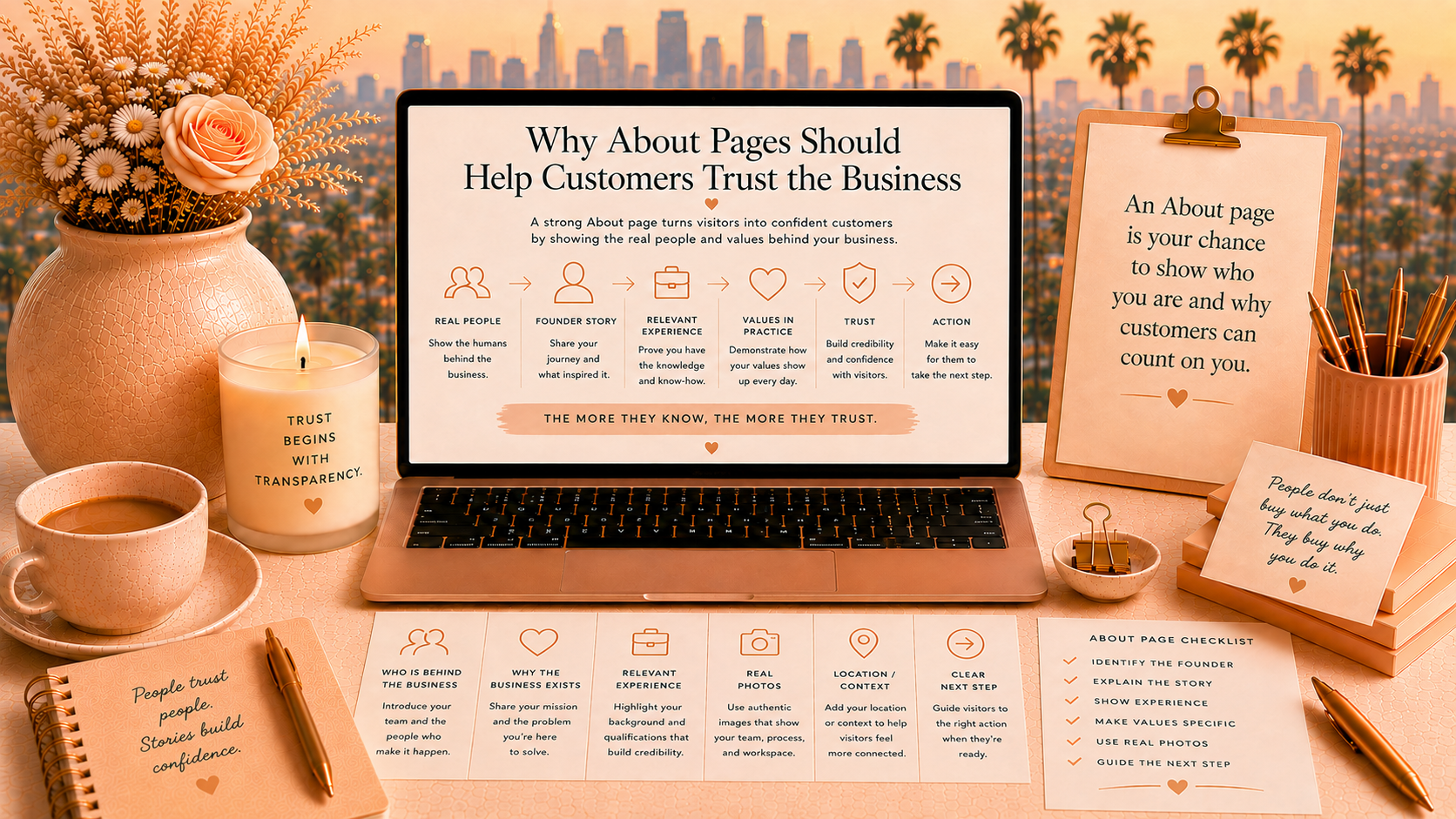
A strong About page should do more than tell the founder’s story. It should help customers understand who is behind the business, why the company exists, and why they can feel confident buying from it.
About pages are often treated as personal biographies.
A founder explains where the idea came from, shares a few details about their background, adds a photograph, and closes with a warm message about being grateful that the visitor stopped by. For some businesses, that is where the page ends.
There is nothing wrong with telling the story. Customers often appreciate knowing how a company began and who is behind it. The problem is that an About page can become so focused on the founder that it forgets the customer.
The customer is usually not reading the page simply because they are curious about your life.
They are often trying to decide whether they trust the business.
That changes the role of the page.
A useful About page should help customers understand who is responsible for the company, what experience or values shape the work, why the business operates the way it does, and what that means for the person considering a purchase.
The founder’s story can still be there. It simply needs to support a larger purpose.
The About Page Is Part of the Buying Journey
Customers do not always visit an About page at the beginning of their relationship with a business.
Many arrive there after becoming interested in something else.
They may discover a product through social media, browse a service page, compare prices, read a review, or spend time looking through the website. Then they click About because they want to understand who is behind everything they have just seen.
That makes the page part of the evaluation process.
The customer may be trying to answer questions such as:
- Who actually runs this business?
- Is there a real person or team behind the website?
- What qualifies them to do this work?
- Why did they create the company?
- Do their values align with the way I want to spend my money?
- Does the business feel established enough to trust?
- Will someone be accountable if something goes wrong?
- Does the story match the rest of the brand?
These are trust questions.
A useful About page should be written with that in mind.
Customers Want to Know Who Is Responsible
One of the simplest ways to build confidence is to make responsibility visible.
An unfamiliar website can feel abstract. Customers may see products, service packages, polished photography, and a checkout page without having any sense of who is actually behind the business.
An About page can reduce that distance.
For a small business, that may mean introducing the founder, co-founders, or team members who play a meaningful role in delivering the experience. A photograph can help, but the explanation matters just as much.
Customers usually benefit from knowing:
- Who founded or operates the business.
- What that person is responsible for.
- What relevant experience they bring.
- Why they chose to build this particular company.
- How their background influences the way the business works.
The goal is not to prove that the founder is interesting.
It is to make the business feel accountable.
A Founder Story Should Explain Something About the Business
Many founder stories are emotionally meaningful to the person who lived them but not necessarily useful to the customer.
The challenge is not deciding whether the story matters. It is deciding which parts help explain the business.
A strong founder story might reveal:
- Why a particular product was created.
- What problem the founder repeatedly encountered.
- What gap they saw in the market.
- What expertise they brought into the business.
- What standards they wanted to improve.
- Why the company operates differently from common alternatives.
- What personal experience shaped the customer experience.
- Why a certain material, process, service model, or philosophy matters.
This gives the story a purpose.
The customer does not simply learn where the business came from. They learn why the business is built the way it is.
That connection is what makes the story relevant to trust.
Experience Matters When It Helps Customers Evaluate the Offer
A newer business may have a short operating history, but the founder may have years of relevant experience.
The About page is a useful place to communicate that background.
A consultant may have spent years working inside the industry they now advise. A designer may have formal training and professional experience. A maker may have spent years developing a particular craft. A retailer may have deep product knowledge from working with customers in another setting.
Relevant experience can reduce uncertainty because it helps the customer understand why the person behind the business is qualified to deliver the offer.
Useful background may include:
- Professional experience.
- Education or specialized training.
- Industry knowledge.
- Certifications.
- Previous projects.
- Technical expertise.
- Creative experience.
- Leadership experience.
- Long-term involvement in a particular community or field.
The emphasis should remain on relevance.
An About page does not need to reproduce a complete résumé. It should provide enough information to help customers understand the expertise behind the business.
Values Are Stronger When They Are Specific
Small-business About pages often include values such as quality, integrity, customer service, sustainability, community, or creativity.
Those values may be genuine, but they are also extremely common.
Customers learn more when the business explains what those values look like in practice.
Instead of simply saying, “We care about quality,” explain how quality is maintained. Instead of saying, “Customer service matters to us,” explain how customers are supported. Instead of saying, “We believe in thoughtful sourcing,” describe the standards used when choosing materials or suppliers.
Specific behavior gives values credibility.
A business may demonstrate its values through:
- Material selection.
- Product testing.
- Customer communication.
- Packaging choices.
- Hiring practices.
- Vendor selection.
- Local partnerships.
- Quality-control procedures.
- Service boundaries.
- Repair, return, or replacement practices.
- Accessibility decisions.
- Production methods.
The point is not to turn the About page into a policy document.
It is to connect stated values with observable choices.
The Page Should Explain Why the Business Exists
A clear reason for existing can strengthen positioning.
This does not require a dramatic mission statement.
Some businesses exist because the founder wanted to solve a frustrating problem. Others exist because they wanted to create a better version of a familiar product. Some were built around a specialized skill. Others emerged because the founder saw a group of customers being poorly served.
Explaining that reason helps customers understand what the company is trying to do.
A useful explanation usually connects three things:
- The problem or opportunity: What did the founder notice?
- The response: What did the business decide to create or change?
- The customer benefit: Why does that matter to the person considering the offer?
This keeps the mission connected to the buyer.
The story becomes less about “why I started a business” and more about “why this business may matter to you.”
About Pages Can Help New Businesses Compensate for Limited Social Proof
Established companies often benefit from familiarity.
Customers may already know the name, have seen reviews, recognize the founder, or have interacted with the brand before.
A new business does not have that history.
An informative About page can help by providing context that a recognizable name would otherwise supply.
For a newer company, the page can show:
- Who is behind the business.
- What relevant experience exists.
- How the offer was developed.
- What standards shape the work.
- Where the company operates.
- How customers can make contact.
- What the founder or team takes responsibility for.
- What the customer can expect from the experience.
None of this replaces reviews.
It does give the customer more reasons to feel that the business is legitimate.
Real Photographs Can Be Useful Trust Signals
Photography on an About page should help customers connect the business with reality.
A professional portrait can work well. So can a natural photograph of the founder in the workspace, a team image, a studio photograph, or an image showing the person actually doing the work.
The best choice depends on the brand.
Useful About-page photography might include:
- The founder.
- The team.
- The workspace.
- The studio or shop.
- The production environment.
- The founder working with the product.
- A real customer-facing location.
- A relevant piece of the process.
The photograph does not need to feel overly corporate.
It should feel credible and consistent with the rest of the business.
Stock photography is usually less helpful here because the purpose of the page is partly to make the people behind the company more visible.
Location Can Make a Business Feel More Real
Not every business needs to publish a street address.
However, giving customers some sense of where the business operates can strengthen credibility.
A service provider might identify the city or region they serve. An online retailer might explain where products are made or shipped from. A local business may provide a physical location and hours.
This information helps customers place the company in the real world.
Location can also answer practical questions about:
- Service area.
- Shipping.
- Local pickup.
- In-person appointments.
- Regional expertise.
- Time zones.
- Delivery coverage.
For some brands, location is also part of the story and identity.
The point is not to disclose unnecessary private information. It is to provide relevant context when it helps customers understand the business.
The About Page Should Connect Back to the Offer
One of the most common weaknesses of About pages is that they become dead ends.
A customer reads the founder story, learns about the company, reaches the bottom of the page, and is given no clear way to continue.
That misses an important opportunity.
If the page has successfully increased trust, it should help the customer return to the buying path.
Depending on the business, the next step might be:
- Shop the collection.
- View products.
- Explore services.
- See completed work.
- Read customer reviews.
- Book a consultation.
- Request a quote.
- Visit the FAQ.
- Contact the business.
The call to action should feel like a natural continuation of the page.
The About page does not need to become aggressive sales copy. It simply should not leave an interested customer stranded.
About Pages Should Not Try to Sound Bigger Than the Business Is
Small businesses sometimes believe credibility requires corporate language.
A founder becomes “our leadership team.” A one-person company begins referring to “departments.” Personal service is described through language that sounds as if hundreds of employees are involved.
This can make the business feel less credible if the rest of the experience does not support the impression.
Small can be a strength.
A founder-led business can say it is founder-led. A small team can identify itself as a small team. A local company can embrace being local.
Customers often appreciate the accountability and personal attention that come with a smaller operation.
Professionalism does not require pretending to be enormous.
It requires making the real business understandable and dependable.
Avoid Turning the Page Into a Personal Essay
There is a difference between personality and oversharing.
A customer may enjoy learning something personal about the founder, especially when it explains the business. But every childhood memory, career turn, hobby, family detail, or personal philosophy does not necessarily belong on the page.
A useful editing question is:
Does this detail help the customer understand the person, the business, or the offer more clearly?
If the answer is yes, it may deserve space.
If the answer is no, it may be better suited for a founder interview, blog post, social content, or another format.
The About page should feel human without losing its purpose.
Do Not Make the Customer Wait Too Long for Relevance
Another common problem is chronology.
Some About pages begin at the very beginning of the founder’s life and work forward slowly until the business finally appears several paragraphs later.
That structure may make sense autobiographically, but it is often inefficient for a customer.
A stronger approach is to establish relevance early.
The first part of the page should help the reader understand who the business is and why they should care. Additional history can follow once that context is established.
A useful sequence might be:
- A concise introduction to the business and founder.
- Why the business exists.
- Relevant founder experience.
- The standards or values behind the work.
- Supporting personal history.
- Evidence, credentials, or examples.
- A clear next step.
This structure keeps the customer oriented.
About Pages Can Support Search and AI Visibility
An About page is also useful beyond the immediate customer experience.
Clear information about the business name, founder, location, expertise, products, services, and history helps search engines and other discovery systems understand what the company is and who is associated with it.
That does not mean the page should be written for algorithms instead of people.
It means basic factual information should be present and consistent.
Useful information may include:
- Full business name.
- Founder or leadership names.
- Location or service area.
- Core products or services.
- Relevant expertise.
- Industry or category.
- Business history.
- Links to important product or service pages.
This information supports both customer understanding and discoverability.
The same basic rule applies: clarity helps humans first and machines second.
The About Page Should Match the Rest of the Business
Trust decreases when the About page seems disconnected from everything else.
If the site presents the company as highly formal but the About page feels extremely casual, the contrast may be confusing. If the social presence is personal and founder-led but the About page hides the founder behind corporate language, the experience can feel inconsistent.
The page should reinforce the same identity customers encounter elsewhere.
Consistency should exist across:
- Brand voice.
- Visual presentation.
- Business name.
- Founder information.
- Service or product positioning.
- Values.
- Location information.
- Contact details.
- Overall level of formality.
The About page should make the rest of the business make more sense.
Customer Questions Can Improve the About Page
Customers often reveal what they want to know about the people behind the business.
Pay attention when they ask questions such as:
- How long have you been doing this?
- Are you local?
- Who makes the products?
- Who will I be working with?
- Why did you start the company?
- Do you have experience with businesses like mine?
- Where are your products made?
- Is this a family business?
- What made you choose this process?
- Who handles customer service?
These questions may indicate missing trust information.
Not every answer belongs on the About page, but many do.
The page should evolve as the business learns what customers actually want to know.
A Practical About Page Audit
A small business can review its About page by asking whether the content increases customer confidence.
Consider the following:
- Does the page clearly identify who is behind the business?
- Does it explain why the business exists?
- Is relevant experience easy to find?
- Are values connected to real business practices?
- Does the page show the people or environment behind the company?
- Is the story relevant to the customer rather than entirely founder-focused?
- Does the page provide useful location or service-area information when appropriate?
- Does the language accurately reflect the size and structure of the business?
- Does the page match the tone and positioning used elsewhere?
- Is there a clear next step after the customer finishes reading?
- Are basic facts about the company consistent across the website?
- Are common trust-related customer questions being answered?
If the page mainly explains who the founder is but does little to help the customer evaluate the business, it has more work to do.
The Vibe Check
Your About page is not simply the place where you tell people your story.
It is where you help them understand who is responsible for the business they are considering trusting.
Tell the story, but connect it to the work. Explain the experience behind the offer. Show the people when that visibility matters. Make your values specific. Give customers enough context to understand why the business exists and why it operates the way it does.
Then guide them back toward the thing they came to evaluate in the first place.
The best About pages do not ask customers to care about the founder simply because the founder has a story.
They show customers why the people behind the business give them another reason to trust what the business is offering.
Leave a Reply