
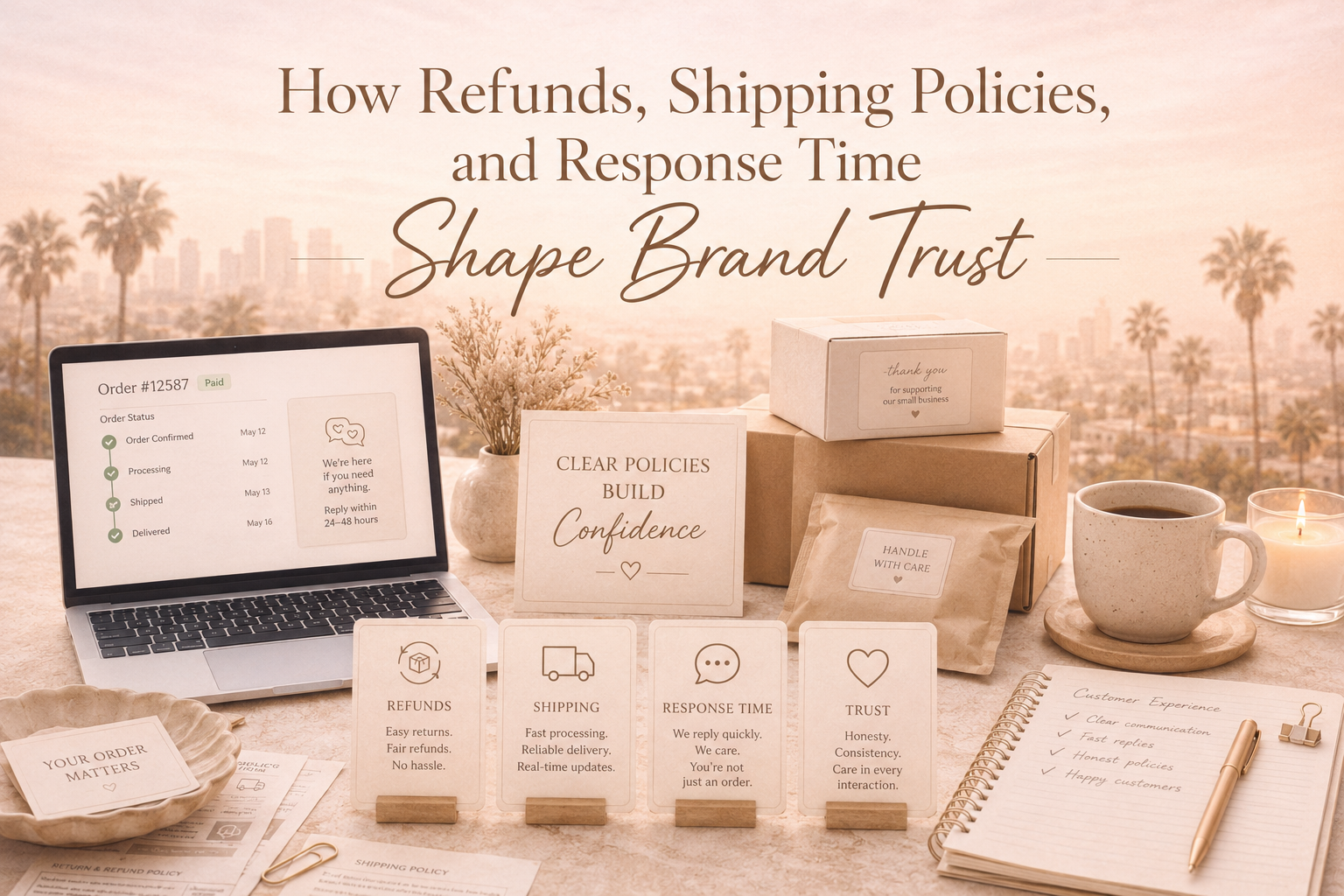
Refunds, shipping policies, and response time are not just operational details. They shape customer trust, reduce hesitation, and make small brands feel safer to buy from.
Small business owners often think of trust as something created by branding, testimonials, product photos, and social proof. Those things matter. A polished website, a clear point of view, and strong reviews can all help a customer feel more confident before they buy.
But trust is also shaped by the quieter parts of the business.
Refund policies. Shipping timelines. Response time. Exchange instructions. Confirmation emails. The way a customer knows what happens after they click the button.
These details may not feel glamorous, but they are often the difference between a customer who feels safe moving forward and a customer who quietly decides to wait, compare, or leave. For a small brand, that matters because every purchase requires a little leap of faith. The customer is asking, “Can I trust this business to handle my money, my order, and my time?”
Your policies help answer that question before you ever speak to them.
Policies Are Part of the Customer Experience
It is easy to treat policies like fine print. Many small business owners write them quickly, hide them near the bottom of the website, or copy language that sounds more legal than helpful. The intention is usually practical. They want to protect the business, avoid confusion, and make sure customers understand the rules.
But from the customer’s side, policies are not just rules. They are trust signals.
A clear shipping policy tells customers when to expect movement. A clear refund policy tells them what happens if something is not right. A clear response-time expectation tells them whether anyone will be available if they need help.
These details shape how risky the purchase feels.
When policies are vague, hidden, or written in a cold tone, customers can feel like the business is preparing for conflict. When policies are easy to find and easy to understand, customers feel guided. They know what to expect, and that confidence makes the brand feel more professional.
Refund Policies Build Confidence Before There Is a Problem
A refund policy is not only for unhappy customers. It is for hesitant customers too.
Before people buy, they often scan for reassurance. They want to know what happens if the item arrives damaged, if the size is wrong, if the service is not a fit, or if there was a mistake in the order. They may never need to use the policy, but knowing it exists makes the purchase feel safer.
This is especially important for small brands because customers may not have years of experience with you yet. They may love the product, but still wonder if buying from a newer or smaller business is a risk.
A clear refund policy reduces that hesitation.
That does not mean every small business needs to offer unlimited refunds. Different businesses need different boundaries. A custom product, a digital download, a handmade item, a coaching package, and a physical retail product may all require different terms. The goal is not to copy someone else’s policy. The goal is to make your own policy clear, fair, and visible.
Customers do not always need the answer to be yes. They need to understand the answer before they buy.
Shipping Policies Set the Emotional Timeline
Shipping is one of the most common places where customer trust is either strengthened or weakened.
Once a customer pays, they begin waiting. That waiting period creates expectation. If the timeline is clear, waiting feels normal. If the timeline is unclear, waiting feels uncertain.
This is why vague shipping language can create unnecessary anxiety. Phrases like “ships soon” or “processed quickly” may sound friendly, but they do not give the customer anything concrete. Soon could mean tomorrow. It could mean next week. It could mean whenever the business owner gets through a busy stretch.
A better policy gives customers a simple, realistic timeline.
For example, “Orders ship within three to five business days” is much stronger than “orders ship soon.” It gives the customer a frame. It helps them understand when to expect tracking. It also protects the business by setting a reasonable expectation upfront.
Clear shipping language does not need to be fancy. It needs to be useful.
Response Time Tells Customers Whether the Business Is Present
Response time is one of the most underrated trust signals in small business.
A customer can forgive a business for not replying instantly. Most people understand that small brands do not have twenty-four-hour support teams. What they struggle with is not knowing when, or if, they will hear back.
That uncertainty can make a business feel less reliable than it actually is.
If you typically respond within one business day, say that. If you do not answer messages on weekends, say that. If custom inquiries take longer, say that. A clear response-time expectation turns silence into structure.
This is not about making yourself available at all hours. That is not sustainable. It is about helping customers understand your rhythm so they are not left guessing.
Predictability builds trust. Even a slower response can feel professional when the expectation is clear.
Customers Want to Know What Happens Next
One of the simplest ways to improve customer trust is to make the next step obvious.
After an order is placed, what happens next? After a customer submits a form, when will they hear back? After a product ships, how will they receive tracking? After a refund request is submitted, how long does review take? After a service is booked, what should the client prepare?
When the next step is unclear, customers become more likely to follow up, worry, or question the purchase. When the next step is obvious, they feel guided through the process.
This is why confirmation messages, policy pages, order emails, and customer service replies should all work together. They should not leave the customer suspended in uncertainty.
A professional brand does not just sell the product. It guides the buyer through the experience.
Clear Policies Reduce Emotional Customer Service
Most customer service problems become harder when customers feel surprised.
A customer who already understands the shipping timeline is less likely to panic on day two. A customer who saw the refund window before buying is less likely to feel blindsided later. A customer who knows response time is one business day is less likely to send three follow-up messages in the same afternoon.
Clear policies do not eliminate every problem, but they reduce unnecessary tension.
They also help the business owner stay calm. When the rules are written clearly, you do not have to invent a response every time something happens. You can point to the policy, explain it kindly, and apply it consistently.
That consistency matters. Customers lose trust when policies seem to change depending on the day, the mood, or how forcefully someone complains. Clear policies give the business structure. They also make the customer experience feel more fair.
The Tone of a Policy Matters
A policy can be clear and still feel unwelcoming.
Some small brands write policies in a tone that sounds defensive before the customer has done anything wrong. The language feels like it was written after one bad experience and left there to warn every future buyer.
That may be understandable, but it can quietly damage trust.
Customers should not feel scolded while trying to understand how your business works. A policy can protect your boundaries without sounding irritated. It can be firm without being harsh. It can explain limits without making the customer feel like a problem.
For example, instead of writing, “We are not responsible for delayed packages,” a softer and clearer version might say, “Once your order is with the carrier, delivery timing may vary. If tracking has not updated after five business days, contact us and we will help you review the next step.”
The second version still sets a boundary, but it feels more helpful. It tells the customer what is true and what they can do next.
Small Brands Need Policies That Match Their Reality
One mistake new entrepreneurs make is copying policies from larger companies or unrelated businesses. This can create confusion because the policy may not match how the business actually operates.
A handmade shop may need more processing time than a warehouse-backed retailer. A consultant may need cancellation boundaries because their calendar is the product. A digital product seller may need clear language about access, downloads, and eligibility for refunds. A local service provider may need weather, travel, or scheduling details.
The best policies are not generic. They are honest about how the business works.
This honesty helps customers make better decisions. It also prevents the brand from promising a level of speed, flexibility, or support it cannot realistically provide.
Trust does not come from pretending to have the same infrastructure as a large company. Trust comes from setting expectations you can actually keep.
Visible Policies Make Buying Easier
A policy only builds trust if customers can find it.
If shipping information is buried in a footer, refund details are hidden on a separate page, and response-time expectations are only mentioned after someone complains, the business is making customers work too hard.
Important details should appear where decisions happen.
Shipping timelines should be easy to find on product pages and checkout pages. Refund or exchange basics should be available before purchase. Service timelines should appear near inquiry forms or booking buttons. Response-time expectations should be included on contact pages, forms, or auto-replies.
This does not mean every page needs a giant block of policy text. It means the most confidence-building details should be close enough that customers do not have to hunt for them.
The easier the information is to find, the more professional the brand feels.
Response Time Can Save the Relationship
When something goes wrong, response time becomes even more important.
A customer who receives a damaged item, delayed order, missing package, or incorrect shipment is already disappointed. The brand’s response will either calm the situation or make it worse.
A fast, clear reply tells the customer, “You are not alone in this.” Even if the issue cannot be fixed instantly, the customer knows someone is paying attention.
A slow or vague reply sends the opposite message. It makes the customer feel like they have to chase the business at the exact moment they need reassurance most.
This is why problem-related messages should be handled with extra care. Acknowledge the issue. Explain what information you need. Give the next step. Set a timeline. Follow through.
That simple sequence can protect trust even when the experience has not gone perfectly.
Trust Is Built Through Consistency
Customers trust brands that behave consistently.
If your website says orders ship in three to five business days, the order should usually ship in that window. If your contact page says replies arrive within one business day, customers should not regularly wait a week. If your refund policy says damaged items are reviewed with photos, the customer should receive a clear instruction when they report damage.
Consistency is what turns a policy from words into a brand standard.
Small businesses do not need perfect systems to begin building this trust. They need realistic systems. It is better to promise a slightly longer timeline and meet it than to promise speed and disappoint people repeatedly.
Customers can adjust to honest expectations. They lose trust when the business sets expectations and then acts surprised when customers believe them.
The Quiet Details Shape the Brand
Refunds, shipping policies, and response time may not seem as exciting as branding, content, or launch strategy. But they are part of how customers experience the brand in real life.
They tell customers whether the business is organized. They tell customers whether the purchase feels safe. They tell customers whether help will be available if something goes wrong.
For a small brand, these details can become a real advantage. Large companies often make customers fight through systems, bots, delays, and policy language that feels disconnected from the person trying to get help. Small businesses can do better by being clear, human, and consistent.
That does not require being available all the time. It does not require saying yes to everything. It does not require copying the most generous policy in the market.
It requires telling customers what to expect and then honoring that expectation.
That is what builds trust. Not just the beautiful photo. Not just the clever caption. Not just the polished product page. The trust is built when the customer feels safe after deciding to buy.
And often, that trust begins with the simple details most brands forget to treat like marketing.
Leave a Reply